
Address fundamental issues like power and wealth
A golden thread to make the scale of change we aspire to
A Lankelly Legacy Interview. Hosted by Generative Journalism Alliance
Chris, what was made possible through your work with Lankelly that wouldn’t have been otherwise?
I suppose there’s three key things.
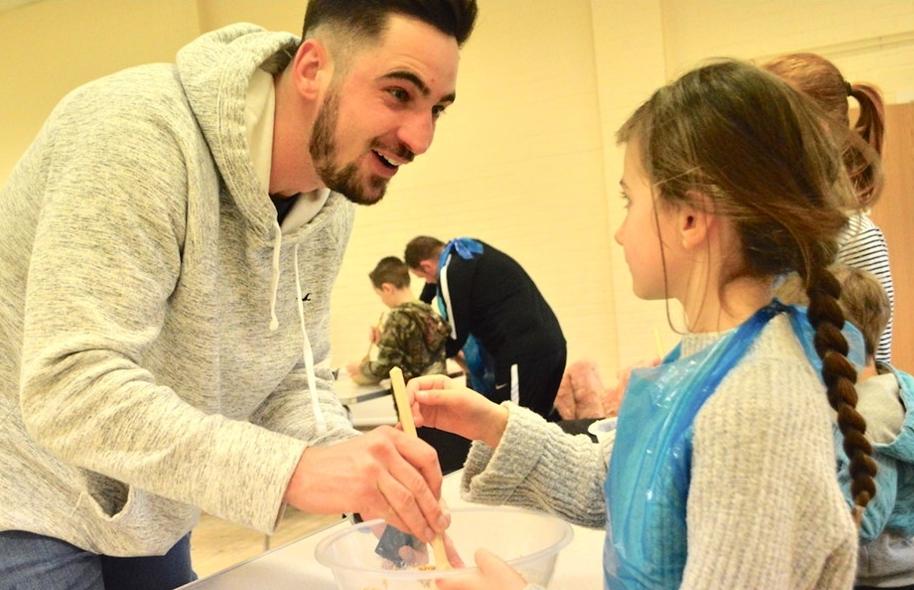
We first had contact with Lankelly more than ten years ago. Initially, it was some support around a project we were doing around fathers and the positive role of dads that affects the health and wellbeing of children.
The second [thing] is that they gathered us together with the other organisations in Greater Manchester that they were funding at the time. This was about 2015, and out of that came something called the Elephants Trail project, which is still going today, although it’s not funded by Lankelly anymore.
The third thing with Lankelly has been about not only how we engage people who’ve had the hardest lives, but how we do that in a way which actually leads to changing systems.
What social shifts have you witnessed during this time?
Well, fatherhood is now recognised within the Children’s Services system because of our work. It’s still early days, but dads are no longer seen just as being a safeguarding risk. We’re beginning to get the system to see dads in a positive sense, with a focus on improving the lives and the life chances of children. We’re now doing a separate piece of work on what we’ve called ‘positive masculinities’. The potential is really wide-ranging, all starting from a tiny little group of blokes in a cafe on a Wednesday afternoon in Salford 12 years ago.
Some of the participants in the Elephants Trail project have now formed a community reporting team, so they make their own videos and they’ve been working with some professional video journalists from The Guardian. The Guardian’s told us it’s changed the way they make their videos.
We’ve been talking with Greater Manchester about how local people who’ve had some of the hardest lives could design what our mayor calls Live Well Centres. The idea ultimately is to create centres offering everyday support to people in every neighbourhood in Greater Manchester. We’re hoping next year that the Elephants Trail will be able to work on designing a completely new type of centre. The phrase I’m using at the moment is: ‘from places of fear to places of hope’.
As an organisation we’ve taken our learning, including from things that Lankelly has supported, and we’re now trying to apply it to what we call economic innovation – things like wealth and ownership and control. Because we concluded that although our social projects on the whole were fine, the problem was at the end of those projects the local people we were working with were still poor. They still didn’t own anything, they had no control. Can we take this way of working with local people, but apply it to economics? We’re trying to push a different understanding of what an economy could be.
Thinking back now to your experience with Lankelly as a partner, funder and collaborator: What, if anything, would you have liked to have been different?
I probably need to tell you what’s really good and then I’ll come back to your question.
The things for me that really stood out working with Lankelly has been about the level of trust and space they offer. Effectively they just said to us: ‘We like what you do. Here’s some money. Produce learning.’ That was basically it. To be given that level of trust and space to do interesting, different things is quite unusual. We really appreciated that.
There were days when I would have liked Lankelly to have said a little bit more about what they wanted – actually to be a little bit more prescriptive than they were. They tended to resist that, which in some ways is a good thing, but it would have occasionally been nice.
I suppose the one other thing we did raise a number of times – probably the one major weakness with Lankelly – is that I don’t think they connected the different projects they funded particularly well. So unless we happened to know somebody, it didn’t ever feel like there was a deliberate effort to connect people up. That would have strengthened things, even if it was just creating relationships. I did feel a bit isolated. I didn’t really know what people [funded by Lankelly Chase] in Gateshead or York or Dagenham were doing. There probably wasn’t as much learning between those places as could have happened. It was one of the things we did raise a few times and it just never seemed to change. I’m slightly nit-picking here!
Thanks for sharing that. As you know, Lankelly has made the decision to wind down as an organisation and redistribute over the coming years. We’re interested in what that could mean for the wider philanthropic sector. What would you like to see now from other resource holders?
There’s two or three things that come to mind.
One is funding that creates a learning culture rather than a performance culture. So it’s more about the learning being produced, not performance indicators and targets and outcomes.
The second thing is more funders, resource holders and so on who genuinely understand how to back innovation – proper, genuine innovation, rather than just funding projects around that – with an understanding about degrees of risk and that not everything will work. And that’s okay.
The third is that, for the nature of the relationship between Lankelly as a funder and organisations like ours not to be transactional, it needs to not just be seen as, ‘you give us some money, we’ll go and do a project’, but something, which is much more exploratory. But also with an eye to how this leads to wider-scale change.
Because there’s lots of philanthropic funders, and they’re not always coherent anyway, and the risk is most of them end up just funding lots and lots of projects. In a sense there’s nothing particularly wrong with that, but I’m not sure how world-changing it is. There could be a bit more of a view of how this is actually going to address the underlying causes of social and economic problems, rather than treating the symptoms.
I’d say the learning from Lankelly is that you have to create a particular type of space, environment and relationship that allows exploration, allows innovation in a serious sense, and also ensures the learning from that is collected so it can be used in a more fundamental way. Because otherwise the risk is, with some funders it can feel like, ‘Let’s fund some projects that work with poor people’. I just go, ‘Why?’ Often it’s just about making poverty and inequality a little more tolerable, and that’s just wrong for me. For me it’s about how we address the root causes.
I guess the one other thing from our experience with Lankelly has been that space to talk about those really fundamental issues like power and wealth. With a lot of funders you can’t talk about those issues because it feels a bit too scary for them and a bit too political. So to have the space to do that, and to think in that way, that’s certainly affected how we operate now.
Almost everything we do I think of in terms of power and wealth now. Because if we’re not addressing that, what the hell are we doing?
What steps are you taking, or are you willing to take, to make that possible? Those shifts you just outlined.
At the extreme, I’d be willing for this organisation to go bust. If that was necessary to make the scale of change that we’re talking about, I’d do it. What I see a lot in the voluntary and charity sector in this country is many organisations whose main purpose appears to be to keep themselves going, and they’ve almost forgotten why they set up in the first place.
At a very personal level, I hope we’re willing to enable people with the hardest lives to say what’s important to them in their own words, in a way that’s meaningful to them, without it being edited. To talk about how life really is, even if that annoys and upsets people who are in powerful positions.
I think what’s particularly critical for us is recognising both those people who are so radical they don’t want to engage with the mainstream system – and we need to encourage that – and also to recognise the value of people who are willing to engage with the system and make compromises. We need both.
There’s a place called the People’s History Museum, which is my favourite place in Manchester. It reflects all of these people over 400 years who’ve had real social or political or economic influence: women who fought for the vote, or Black Lives Matter, or whoever it might be. I go into this museum sometimes just to get re-energised and reflect on what these great people did.
One of the things I’ve learned from them is you have to lose quite a lot if you’re really going to make this scale of change that we’re aspiring to. You lose most of the time – but every so often you win. I think of it almost like a golden thread now. How do we draw on and learn from those great people from the past? What can we do now, in the current environment? And lastly, what can we do to pass this thread on to future generations? Because the struggle never ends. There’s no stopping point for this.
You’ve also pretty much answered my final question, which is great! It was a lovely segue. I’ll ask it anyway: What’s the best thing that could happen, thinking about the work that you’re doing into the future?
One of the best things that could happen is that eventually somebody will come along who will get rid of me and take over my job!
The second best thing that could happen is for social and economic innovation to be taken as seriously as all other forms of innovation, in the way that it was in the nineteenth century. When the Industrial Revolution started, almost literally where I’m sat now, the amount of social innovation going on was just enormous. And it faded away.
Ultimately, the best thing that could happen is that every child, and all the children in future generations, all genuinely have a chance to do what they’re capable of without all of the barriers that are in the way. This is fundamentally a struggle about power and wealth, and if we really want this stuff to change, we have to get rid of the political and wealth barriers that prevent many people having really decent, meaningful lives. All we need to do is basically redesign all of politics, the whole economy and get the environment right – apart from that, it’ll be easy!
Chris, thank you so much for sharing your story, visions and everything else with me.
Hosted by Jack Becher. Edited by Sam Walby
Learn more about Generative Journalism Alliance