
Building an economy rooted in care and liberation
We need a movement infrastructure in which funders are the organisers themselves: Guppi and Noni
A Lankelly Legacy Interview. Hosted by Generative Journalism Alliance
Guppi and Noni, could you tell me a bit about your relationship with Lankelly Chase?
Guppi: We were contacted by Habiba who invited us into a learning process around building an economy rooted in care and liberation. This was back in 2022.
It was a perfectly timed conversation, because it aligned with a project that we had been thinking about. We’d already got a small bit of funding to begin, and then the learning grant that Habiba had offered us had enabled us to do significantly more than we thought we were able to do.
We established a programme called Nourishing Economics, which not only included running a political education and practice series with solidarity economy organisers, but also meant we could engage in some kind of re-granting and redistribution within that process.
I’d love to hear more about that work, and what was enabled through that?
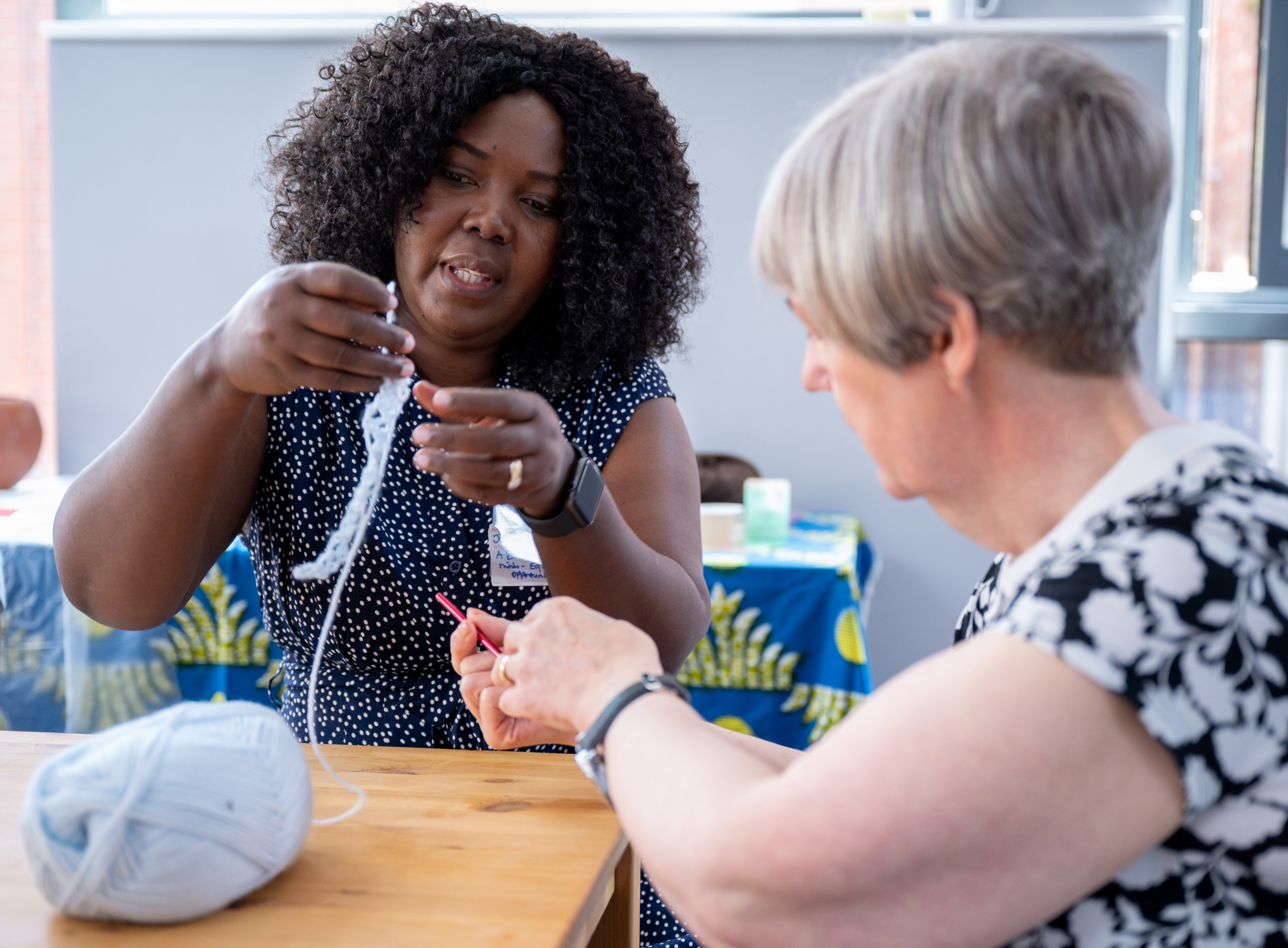
Noni: We started to think about inviting Black and People of Colour across the UK who were doing something within their communities that meets community needs using those principles of solidarity economics. Then we invited artists, growers, housing experts, and people working in all types of sectors, basically to explore what solidarity economics means to their work, and to get them to meet other people who are doing similar things and understand more about their needs.
As part of the programme, we asked: How can we redistribute some of the grant that we’ve got from Lankelly to be able to seed their ideas over a period of time? With the redistribution process of: How can we develop collective decision making processes with the people that were part of the programme?
We did this over three retreats. We had some sessions on intergenerational organising. We had some other sessions where we got to invite people within our ecosystem to share more about their work.
Guppi: We were collectively designing and strategising around a vision for an economy that was rooted in care and liberation, which was ultimately what Habiba had initiated in a conversation with us, but the extent to which we were able to meet everyone’s very diverse needs, I think, is really important.
One of the things that enabled the retreats to happen well was the resource to actually be in a building that is accessible to wheelchair users, has access to nature, and allows us to cook our own food, and genuinely makes people feel like they are able to rest and have their own space.
It’s really exciting to hear about the work. In this, what support did Lankelly offer beyond the financial side of it?
Noni: Habiba was really supportive of us. I think we had been really struggling with the resource to make this happen, and then not only did we get the resource we got to chat to Habiba, she would be really excited about our vision, and it felt like she really understood where we were going and what we needed.
Guppi: She instinctively understood. Even if she didn’t understand, she didn’t make it a point for us to have to explain. So she just offered the trust through understanding that the kind of work that we were doing was something for her to learn through our partnership, as opposed to needing to know it before signing off, which was an approach that we felt was very distinct. We never once felt like we needed to prove something to her.
Noni: It never felt extractive.
In your relationship with Lankelly, what, if anything, would you have liked to have been different?
Noni: I felt like the change of strategic priorities at Lankelly was a bit disorientating as grantees, because whilst we understand the need for reparations, it felt like the process wasn’t as collaborative or clear.
We’ve built this huge programme, and then it just stops. It was a bit unsettling, because it’s like we weren’t really sure what would happen next with our collective.
Guppi: I think even pre-decision [to close], Lankelly was quite an ambiguous funder. The way that they had created learning partnerships, and everyone knew that they were a foundation that gave out grants, but no one we knew actually knew how to get a grant. Before Habiba had contacted us, we never even considered it to be an option for us. We didn’t even know what the entry point was of this elusive organisation that seems to have quite a tight knit. I think it’s an indication of what happens when staff who have different relationships come in and observe what ‘the movement’ is differently to previous staff, and then bring that into the organisation.
But even now, as grantees, it is weird to be funded by someone and then not be able to advocate for others in your movement ecosystem so that you can also receive some collective resource for everyone. I think that has always been a tension. I don’t know if that has ever been addressed. There’s very little transparency or democracy. I think that is one of those things where a fund makes a decision that helps them internally, but it has consequences externally for relationships beyond the organisation itself.
How have your perceptions of them changed over time?
Noni: It feels like it’s not as democratic as it presents itself to be.
Guppi: We don’t know where the relationship from Habiba came from, which leaves us not knowing where we land afterwards. It has been weird being a grantee who had to observe everything that’s going on with a relative amount of uncertainty.
The operations of the organisation are so elusive. You realise that actually it’s just maintaining a power structure that already exists within the movement and needs to be challenged.
Can you elaborate on that?
Guppi: I feel like institutions are drawn to what they know in times of crisis – back to what’s familiar. I think that’s a shame, because the familiar relationships come with their own dynamics. There are so many other people outside this tiny London bubble who have the skills and expertise and leadership to partake in these conversations.
How has your experience with Lankelly changed your approach to other funders?
Guppi: We hadn’t really experienced from anyone else what we experienced from Habiba, who is actually the only Black grant manager [who we’ve worked with].
It enabled us to be able to have a conversation where we felt very safe and settled. It’s enabled us to sense with other funders where we don’t feel safe in the relationship, or we feel like the culture of the foundation doesn’t match.
Plus, when a fund is like, ‘We need this information, and we need you to have this thing’. We can say, ‘Well, Lankelly is a charitable foundation that doesn’t need all these things, so there’s no reason as to why you would need this either’. To be able to negotiate on the expectations and the reciprocity of the relationship differently, given the structures are similar.
What would you like to see now from the wider philanthropic field?
Guppi: More resources that can be distributed outwardly towards an ecosystem, not just going to an individual organisation. There are active ecosystems out there that need collective resourcing.
Also movement infrastructure funding and resourcing of important skills, such as: media, facilitation, rest, healing spaces, access to services that enable things to operationalise faster. Processes, like the one that we had, which are quite neurodiverse friendly: ‘Just tell us what you want to do, and we will write it up and then review it back with you’, so people aren’t filling out complicated forms that the funder determined are the questions they want to answer.
I think a lot of these things are clear to people in movement spaces, but there’s a big gap between them and the people funding them. What feels most pressing in the movement spaces you’re active in?
Guppi: There was this weird move in the early 2010s where funders were like, ‘Oh, we should be doing movement building and not funding services’. But that binary [isn’t helpful]. People need access to services because the state has pulled itself back so much. So where are communities actually accessing safety and care? And where are community centres at risk of falling apart or shutting down? And how can you sustain community infrastructure more effectively? So that people aren’t in crisis all the time.
It’s a role that funders need to play, which could look like service provision, but is actually very necessary, meeting immediate needs alongside movement building infrastructure that enable folks to then think into strategy mode. You can’t just do one or the other.
Noni, would you like to add anything?
Noni: Yeah, what we’ve experienced within our collective is the need for gathering.
The need for spaces for communities to ‘just be’, without doing crazy funder outputs or things that look really shiny. Actually just being in community and developing those relationships together.
I think one of the things that we’ve also been witnessing within the communities that we work with is the issue of buildings, as Guppi mentioned, but places to work or places for community groups, because I think everyone is so isolated as well.
Where do you see opportunities to exercise agency in those dynamics, and what would you like to see if that was successful?
Noni: I just feel like everything is so transient within the philanthropic sector. Even though you can have agency in terms of how you are interacting with them, it’s quite limited. It’s about how you talk or how you present in spaces. So I feel like agency is just quite dependent on who you’re working with and whether they’re able to help you to translate a lot of the work that you’re doing. It requires a lot of mental gymnastics to be able to get the things that you need resourced.
Guppi: I once had a vision that you could dismantle philanthropy, and the endowments would be collectively governed. I’m not entirely won over by that vision anymore, because I think either we have philanthropy and we just have very nice grant officers, or we don’t have philanthropy and we just survive within what we can at community level with our own resources. It’s just an institution that’s set up to not transform.
I am interested in what happens with Lankelly. But it’s a tax haven. It’s set up for the extractive system to reduce tax spending. So, it does some good, but ultimately it’s an institution that can’t do anything more than that. It can’t do anything particularly radical. So it might best be something for a small amount of time and then it won’t exist.
Setting aside practicalities for a moment: If the messages are received and the dialogue and relationships open up in a generative way, what’s the best thing that could happen?
Noni: Moving away from having individuals who have so much power over what happens with the rest of the community organising – that would be the best thing that would happen.
It’s very closed and clique-y, and if you’re not part of it then you don’t get resourced. For that whole system to not exist, where there’s more diversity of groups and organisations, and there’s more risk taken for organisations that just don’t have lots of buzzwords and look cool. Divesting from the monopoly of organisations that receive funding whilst other people don’t.
Beautiful. Guppi, what about for you?
Guppi: I agree! There should be a different structure in which funders are basically organisers themselves, and have the relationships and know where things need to be distributed.
Thank you, both.
Hosted and edited Jack Becher
Learn more about Generative Journalism Alliance