
Lankelly will have ripple effects
They’re going out with noise and defiance because they don’t agree with how things are done
A Lankelly Legacy Interview with Ursula Myrie and Nigel Wilkes. Hosted by Generative Journalism Alliance
Ursula and Nigel, can you share a little bit about how you came into this, your relationship with Lankelly, and how your experience has been working with them?
Ursula: I think Lankelly Chase stumbled across our website and the work that we did and approached us, and I said, “You know what? I’ve always wanted to make a film based on my lived experiences of the link between Black hair and Black mental health”. They got really excited about that, because this was an avenue that they had never gone down. They’d never made a film before.
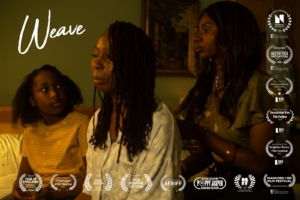
Nigel: I put together a presentation to Renee from Lankelly Chase about what we wanted to do, how we wanted to do it, the non-negotiables. We wanted mainly African Caribbean cast and crew. We wanted it to be shot in Sheffield. We were aware that the film that we were going to produce may have some things which were contentious, and we didn’t want them to silence our voices. It was really, really important for us, right from the off, to be able to tell our story.
Ursula: The main reason I think this worked, in terms of the relationship between Lankelly Chase and I, was Renee. If it had been a White person that had approached us I don’t think it would have happened the way it did, because a White person would never have been able to understand the importance of doing a film like that.
Renee having her own personal hair struggles, being very open about that, really was what cemented the relationship. We didn’t have to sell it to her. She just got it. That definitely was the linchpin in the relationship between ADIRA and Lankelly Chase.
What meaning was made for you through this experience?
Nigel: For me, it’s been a spiritual experience. The relationships which we made during this time have been really, really strong. We can check in with each other and feel like we’ve been friends for a long time, but everybody knows everybody was aligned with the impact of what we were doing. That was just so powerful.
The other thing was, when we had the launch of the film, for some of the volunteer organisations, I think there is something which says, ‘You know, with the right kind of mindset, the right kind of people, right kind of support, they could do things as well.’ ADIRA paved the way, in quite a lot of respects, to help other people see that they too can achieve their dreams.
Ursula: Everything happens in its time and needs to happen in its time and shouldn’t be forced. That’s definitely something I learnt from that experience. I remember saying to somebody at the launch event, “This film took us two years to make,” and they said, “No, it didn’t Ursula, because you said in your speech that this idea was born over 30 years ago while you were on the psychiatric ward, and that means it was 30 years in the making.” And I went, “Oh, my God, you’re right”. It really was 30 years in the making. This film is in my head.
30 years in the making, and I almost gave up on the idea of ever being able to make a film. This has shown me: never give up on your dreams, no matter your age, circumstances, changes in life. Never give up. That will be one of my takeaways from this.
Thinking more specifically about the relationship you had with Lankelly Chase: What, if anything, would you have liked to have been different?
Ursula: More money.
Nigel: We were able to attract resources to us for free. Things like the cameras. We had a conversation with Sheffield [Hallam] University, their film school. The director was an alumni from the university. His lecturer said if we could shoot in the downtime when the students weren’t using it, we could use their cameras – industry standard – which saved us a lot of money. And in saving us a lot of money, also saving Lankelly Chase a lot of money. I reckon we probably saved about £8,000. That’s through telling the story, getting people to connect with it, and people want it to be a part of it.
If I’m being forward thinking, there are many other stories that are there to be told. If, after this, there was an opportunity to say, “You’ve made this, would you like to make another film? We know that you can do it, so we’ve got 100% trust in what you’re going to do. We know the impact that it will have” – it would have been great to be able to look at doing another film and having a little bit more money to tell some more amazing stories and be equally impactful.
Ursula: What I think Lankelly Chase did well is they did not interfere with the process. They were kept in the loop. I don’t know whether that was because they know Renee, so they completely trusted Renee, or if it really was the death of George Floyd. It might have been with Lankelly Chase that actually they meant it when they said it and they understood that a part of that process is, if we’re going to work with a Black organisation, especially one that is so small, we’re not going to try and swallow them or dictate to them how things should be done. This is going to be you lead and we will follow. I think they did that absolutely brilliantly.
What would you like to see now, going forward in the future, from other wealth holders?
Ursula: Make sure that the people who are sitting on the decision making table are as diverse as possible. So you would have somebody there who is disabled, and you would have somebody who’s Jewish, and you’d have somebody from the Muslim community and from the Black community.
I think that’s what I would like to see in terms of change – real people with real lived experiences either giving out the money or, if that can’t happen, bring lived experience to the table.
I want to see those people who are philanthropists and givers, either get down to communities before you make decisions about where the money is going to go, or hire people with lived experiences of working and living within these communities, to say “this is what would work, this definitely would not work” in those communities.
I’ve walked away from money when it comes to funders because it wasn’t right. The way they approached me or my organisation wasn’t right. It has been when we’ve said, “Oh, but this isn’t right, and this is what we need to fix it”. And they found some crumbs from somewhere, throwing it at us like we’re dogs, and say, “Well, okay, here you go”. We’re expected to look down on that money on the floor and pick it up and [say], “Oh, thank you, sir. So grateful, sir”.
I’ve had to happily stick two fingers up and walk away from it. What has happened within situations like that is they have a deadline that they’ve been given by that funder. How they give the money is very, very important. How they give it, how they offer it, what the approach was in the beginning is very important.
I think philanthropists need to understand that it’s not always about money. When you’re engaging with organisations, sometimes it’s about the skills that you have within your team, the knowledge that you have within your team. Sometimes it’s about the resources that you have. Sometimes, come with that mentality: ‘I’m not going to give you a million pounds, but I can give you resources that will be more valuable to you in the long run and is worth more than a million pounds.’
I want to ask, because you speak to this relationship – an equal partnership, is what I’m hearing – what steps, if any, are you already taking, or are willing to take, to make that possible?
Ursula: I started taking steps years ago by telling White people, ‘no’. And when they would ask why, I would tell them that ‘no’ is a whole sentence. I don’t need to explain nothing, because you know why I’m saying no and this is how you exhaust us.
So I started years ago by saying ‘no’ – no to how they approached us, no to how they would want to engage with us, no to how they would parachute in and drain and bleed our Black gold, which is our lived experiences and our trauma and our time, which is incredibly precious. If you want to approach us, the approach must be right. It cannot be a hit and run.
Nigel: It took a while for me to actually understand exactly where Ursula was coming from, and the impact it was having. With the rebuttals came a lot of mental torment, mental trauma. With Ursula being the CEO of the organisation, she was actually doing that, but she was doing that for a reason, and it was to move the organisation forward.
Ursula’s voice is a unique voice. There are not a lot of people who can speak in that way. It takes years of cultivation.
Is there anything that you expected to share today, or that’s come up now that you’d like to add before we conclude?
Ursula: I’m saddened by the fact that Lankelly Chase is closing down, and that they’re bringing the amazing work they’ve been doing around social justice for so long to a close.
I love the way they’re doing it. They’re not going out quietly into the night. They’re making as much noise as they possibly can. I think this will inform other organisations who are just as big, who are doing work around social justice.
The fact that they are doing it in such a defiant way because they’re not happy with the way things are going, and they’re not happy with the changes being made – I absolutely love that and I commend them for that.
The impact of the way they are closing down will have ripple effects, I think, for years to come, and will have significant change. So I’m saddened, but at the same time seeing what difference it will make in the way they’re doing it and the impact it will have brings a lot of joy as well.
Thank you Ursula, thank you Nigel.
Hosted by Jack Becher. Edited by Maryam Jameela
Learn more about Generative Journalism Alliance