
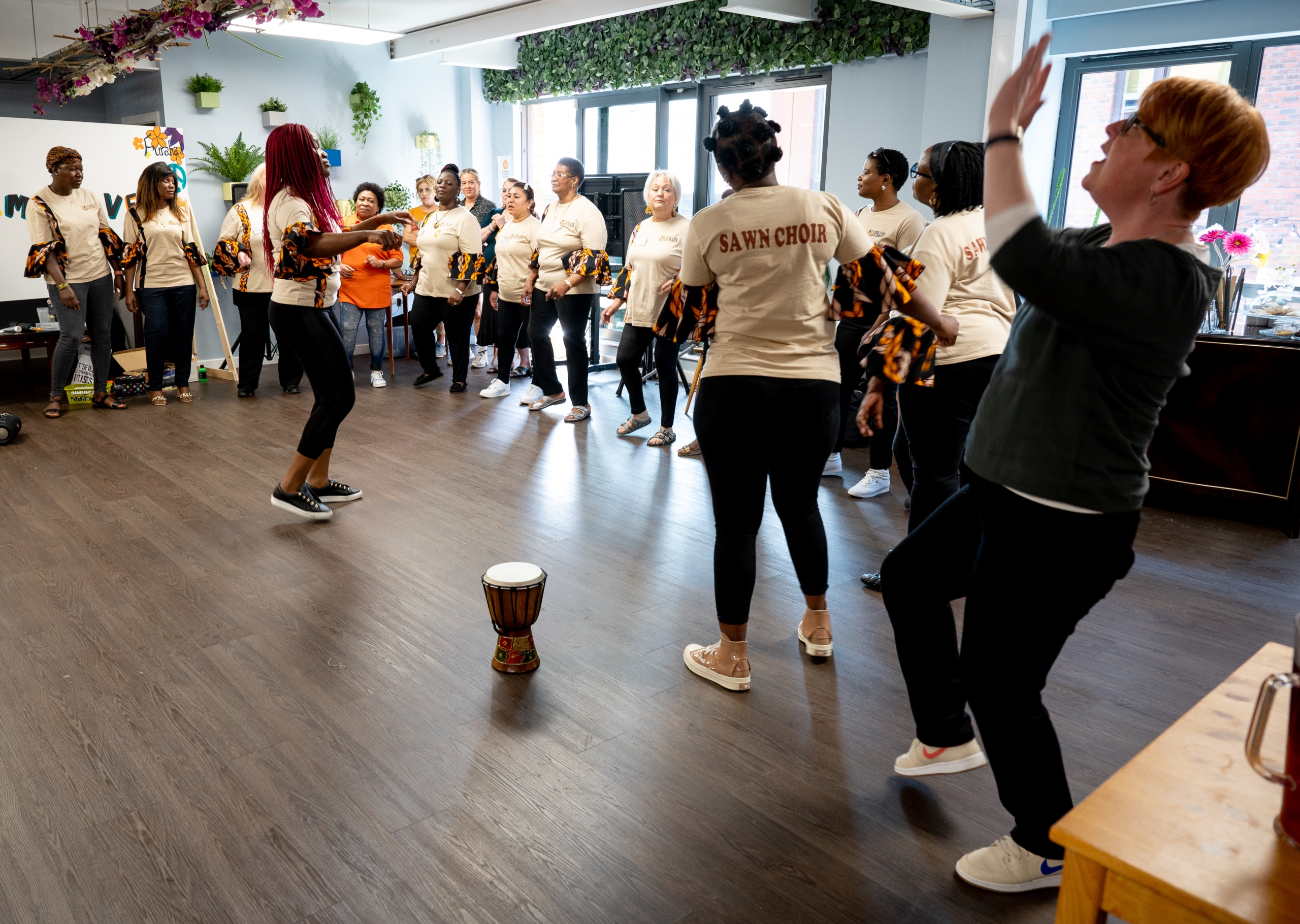
Manchester System Changers establish new way of doing things
The future is great. Hopefully we’ll still be in it together: Rose Ssali
A Lankelly Chase Legacy Interview. Hosted by Generative Journalism Alliance
Rose, can you tell me about your involvement and relationship with Lankelly Chase?
We were a Greater Manchester System Changers core group. Then in the last year, we’ve become the temporary stewards, we were all contributing and identifying areas of need, especially for black and minority groups in Greater Manchester. Creating a space, a safe space for us to talk about how to support people to bring their needs to the forefront. And out of that, we had emergent strategies that came out, and we were looking at different areas of work, contributing to funding of small groups, and holding spaces, like the Dream Weavers. All the funded groups came together to add their voice to the contribution. So from that we are temporary,stewards holding what we might become. We don’t know what we’re going to become yet, especially after Lankelly Chase money runs out, right? Which it has. So we are temporary stewards of what we are building together.
Were the groups and organisations that came together prior, or was that coming together catalysed by Lankelly’s involvement?
They were already there, including ours, my own organisation, but I believe if we didn’t have Lankelly’s intervention during COVID, we wouldn’t have survived.
What I brought is I surfaced the needs of black African women and organisations and leaders like myself in that space and we had the opportunity to distribute funds to look at all those emerging strategies, making sure organisations survive during COVID, keep them spaces where people were kept alive, where people went for food, where people went to talk to each other, where people went to be because it was hard times. Then right from that, now we have the cost of living. So the funds that Lankelly has been plugging in have been helping to keep people going, to keep organisations running.
What was made possible as a result of the relationship with Lankelly that wouldn’t have been possible otherwise? It sounds like the survival of the organisations that were supporting people was one of them. Are there others that come to mind?
Yeah, because what Lankelly enabled devolving power to us to make decisions as part of the organisations in the community was that the scrutiny you get from funders, which is to account for every penny….
When we set out to start a community group, we were not bid writers, we were not accountants. We started from a place of passion, a place of need, a place of creativity. However, you need to understand that when you are a small organisation, you are the organisation’s everything. So you are the bid writer, you are the chair, you are the cleaner, you are the everything – you and a few others.
Lankelly removed all that and simplified the process of application. Their approach was, “Just tell us what you want to do, how you want to do it, where and with who.”
The grants we distributed were just a very simple application, and then we went back as a core group and made the decisions on who needs it more than the other, that decision process was between all of us. And when we finally got money to people we had one-to-ones with the person who put in the bid, or the lead, and it was a matter of ‘tell us how things are going, what has gone well’. No tedious reports, no tedious outcomes, no tedious targets and numbers and all that. We made it easier for people. Then we had another grant, because from what people told us, what emerged was what we could do with a little bit more money to carry on what we’ve started in these spaces. So that’s what we did.
And then the Dream Weavers came out of that as a space to share the learning and celebrate, really celebrate what we have achieved together.
What came out of that is that we’ve created networks.
There’s so many people who have contributed to what we are today, who we met through them. People who we would never have met. And because of that, we’ve been able to go to other spaces. As an African woman, to learn the appropriate language that funders want to hear in the voluntary sector means a lot. It could be the difference between being funded or not, or sounding like you don’t know what you’re talking about or sounding very sure and confident.
So we had a lot of connections that were strengthened. We had a lot of networking. We learned a lot of communication. There’s been lots of training as well, like Deep Democracy, which my team was able to benefit from. We are using it going forward when it comes to decision making. There was a lot of communication, there was a lot of learning.
How many rounds of funding were there?
Two rounds. I think there was a third one, like a top up. So, three rounds really.
How did the capacity for, and the practice of, the devolved decision making unfold over the period of those different rounds? Did you have a pattern that was established right at the beginning? Or did the practice sort of grow and evolve? And, if so, how over those several rounds?
Originally, I think we were six of us. We were paired. We were pairing ourselves up, to support grantees. We knew their needs. We supported them depending on the needs, because different organisations had different needs and were different sizes.
We were paired up, working together, listening to their needs and the emerging changes and challenges.
The first round of money from Lankelly came to us as the core group.
By the time I joined, money came to us, and then we would go back and say, ‘I think this is how much we need for the next round’.
Then we would get that, but it was just us making the decisions.
From that it evolved to participatory grant making. So now it was us.
We do that for two, three times, and then the participants themselves now start deciding among themselves again, using Deep Democracy and a lot of mutual agreement around who we should bring on board? So it was them participating in the grant making process and us respecting their decisions.
The first step was for participants to invite others to be involved in the participatory grant making?
Yeah, because this is how big the network is. So the first organisations, I think it was 40 organisations that got a small grant, and then from those 40 organisations, there were two more grants.
But then we had the Dream Weavers, where we invited all of them to showcase and invite other people. It was a big event, I think over four days, whereby people showcased. W also gave an opportunity to people that were not funded to take part. So we even have a relationship with unfunded organisations.
The devolving of power didn’t stop with us. It was taken further into the participatory grant making. So then they distributed funds and made decisions based on the needs and the new people.
They divided, then, from the core group because of the emergent strategies that we had, which included the Island of Sanctuary, meaning spaces, safe spaces that we’ve created.
Then we had the inquiries, which included organising themes such as healing, governance, good, sovereignty, land justice, policy making and economic justice.
But also we identified that there might be one that we don’t know about yet, that will be imagined when we start working.
So because of that, instead of us being six people, we even devolved further. So Lankelly, that is Carrina and Karen, left it to us to become the temporary stewards.
That’s when Lankelly made its announcement about closing. So because of that, we are now focusing on what we are going to become without Lankelly money. And if it’s just money binding us, what do we do to get more money to keep us going? That’s the reality. You need money to keep functioning.
You’ll be drawn to spaces or places where you get money to pay your bills, but also to keep your organisation functioning. So that’s where we are at now, looking at structures of what we can honestly become.
What are our relationships without Lankelly money? We’ve been at it for a year now, almost a year. We are looking at proposals of what the future holds. What can we do with the little money we have left?
Can we attract new money? If we become a certain entity, if we become a structure, if we want to attract money, we must be something.
Now, what are we becoming? Are we together because of money? If yes, then let’s be honest, where do we get more? Do people want to carry on as the temporary stewards, or do we just carry on as a big network? So we are there at the moment, and are looking at emerging questions as well.
We’ve involved every person in the network that you can think of, held forums in all our spaces for people to contribute to certain questions – the where, the what, the when, the how, of the future.
Do you have a sense for what’s bubbling to the surface in that conversation?
I think people really, really want to work together, because everybody is very passionate about what they’re doing, but also in doing so we still recognise ourselves as individual organisations, as part of a collective.
There’s a good feeling about people wanting to work together, and sustainability, because it’s very important that we don’t just disappear after what we’ve been doing together.
We’ve invited in people who are doing good things that we can see as examples. Some people are bringing in investment. We’re looking at land or a building together. What can we do? How can we get hold of a building, at least to have a space where we can work collectively? Somebody wants a commune. Basically, Afshan wants a commune whereby everybody can be welcomed and, you know, do things together.
Could we spend a little bit more time on what the participatory grantmaking process was like? Was it a foreign idea, or did it seem natural? From the outside looking in, I might think that, oh, well, were people competing for the funds, and did that create tension? I’m curious about the process by which the community made those decisions.
I was not part of the participatory grant making, but I’m part of a partnership called Mama Health and Poverty Partnership, which has 10 organisations, black-led women organisations.
Some of my colleagues were part of the participatory grant making, so I got an insight on how things were.
It was very new to them, because nobody has ever given any of the communities that responsibility and opportunity.
So it was exciting, but at the same time challenging and very, very hard to make the decisions, because everybody is deserving, and what makes one organisation more deserving just because they can write a better bid over one that doesn’t have somebody who writes good English. So the challenges were there, but at the end of the day, organisations did not get the amount they put in originally. So people who put in for about maybe 30k only got half of that, and the other half went to another organisation. So there was a lot of negotiating, there was a lot of democracy. There was a lot of sharing and embracing new people that have never been part of Lankelly, that have never been part of the network before, in terms of receiving funds.
So one organisation that has received funds paired. Then one new one to deliver certain aspects of work. So there was a lot of compromise. There were a lot of challenges, which they recognised. And, just like me before I became part of Lankelly, had never been anywhere near funds. I’ve always been on the other side. And when you’ve been on the other side, you have more understanding, because you know what people go through, which makes it even harder for you to make a decision.
But they did. It was a hard one, challenging. There was a lot of learning to do, and they really, really engaged well with each other.
I imagine that process would have strengthened relationships as well as understanding of the process and the ecology as a whole. Is that the case?
Yeah, yeah, you did. You did a lot.
Do you have a sense for how satisfied people were with the final decisions?
It is a new way of doing things.
The scrutiny wasn’t there, that scrutiny that you would go through to apply for funding.
Right now, we are working on a small bid and they’ve asked us to tell them what we’re going to do with the money. We have shared a budget, but they want a more detailed one: What is this session worker going to do in the 20 hours? It’s a new project. We don’t know what the session worker will do apart from the basics of preparing a work plan, going out to meet people and networking. So really now my colleague is spending more time on just that.
We didn’t have that with Lankelly when it came to reporting. It was just a little dialog like me and you now are talking, because that’s how life works, right? It promotes honesty. Whereas if somebody scrutinised you so much in the beginning, you have to make things look nicer than they actually are.
But with Lankelly’s way of doing things, that participatory grantmaking, and because the grantees, even the participants, were part of the grant making, they’re able to go back and say, ‘You know what? That didn’t actually work well, but this is where we are stuck. How are you doing over there?’
What is working is good, because that’s what we expected.
But I love focusing more on what has not worked and why. Why did the women not turn up? Mm, did we do it in school time? Was it the weather? Was it the language? Was it the food? Was it the venue?
So that’s more important than when everybody is standing up and yes, it’s good when it goes according to plan, but life never does. Nothing ever goes according to plan. At least in my world, nothing ever does.
So why not start there, right?
It sounds like the network and the community would like to continue to work together, and in the same ways, and to continue with the deeply participatory, devolved way.
Yes, yes, it’s a good way. Because when you go back to the real world, where things are different, you find it even harder, but you start challenging. Why do I need to tell you every single detail of that?” You start thinking of things like, “You’re going to only give me 10k and I’m going to spend 12 hours just answering questions, another 12 hours on the report. What are we going to deliver?” Maybe I’ll just leave that 10k and look for a bit more money.
So the learning is enabling us to think bigger and participate in places that we really, really need to be, instead of wasting time .
Having been through the community building that you have been through and the processes, I presume that would make everyone feel stronger to say to a resource holder or a funder, why am I doing all of this for 10k?
Does this present the community with more strength in the face of, like you said, the real world? To what degree do you feel the community is stronger because of this, and would be better able to self advocate for a different way with future funders?
Not just future funders, even all stakeholders. We’ve learned about systems. So every organisation has an opportunity, because we are Greater Manchester System Changers, they’ve been able to participate and understand what systems are.
We don’t have systems where we come from. We have what we do, but a different kind of system, right? Corruption. You know, dictatorships in Africa. Somebody is in power for 40 years, and there’s no hope of him ever leaving. We’ve given up. But you have elections every six years or five years, so that’s what we are used to.
But when we come here, these systems are just as bad, but in a different way. At least we change the face now and again. So understanding how the systems here work, understanding our role, my role, understanding how they work. We can’t sit and wait for things to happen.
How do we challenge positively?
We’ve all learned that by being in these networks. When we go out there now, we are in a better position to say, “No, we can show you a different way of doing things we’ve learned.”
I’ve shared this with the Tudor Trust. I’ve shared this with other spaces, “You know what, this is what we’re doing as System Changers in Greater Manchester. For the last four years, we’ve been part of this. These are the results. These are the organisations that have been able to understand that just firefighting will not take us anywhere. We need to do firefighting, yes, because we need to keep people alive, but we also need to participate in changing policy. We need to create that dialog with people we don’t like, but we have to be there.”
So that’s part of being part of the systems.
That’s the difference that has enabled us and every single organisation to be able to learn how to challenge, to understand the language, to understand how to present our own needs.
How do we say that this is what we want?
Wherever people come from, they have skills, they have the education, the qualifications, but you can’t work here because you’re an asylum seeker, because you have no recourse to public funds. So how do we challenge that if we can’t come together and present it? So that is what we are learning. That’s what we’ve learned as individuals, but also as a collective and that’s what I’m hoping the temporary stewards will emerge.
We are ready to challenge, be assertive, but not aggressive, not fight, just be assertive. Yeah, assertive and intentional.
Beautiful.
What would you like to see happen next?
What I’ve wanted from day one of being in the voluntary sector is equity, so that we meet somewhere in the middle, because everybody has different needs. So how can we make the voluntary sector equitable for organisations to access funds? Because challenges and problems will always be there – poverty, cost of living, ill health, mental health issues, abuse – they are never going away. They’ve always been there since time immemorial.
We are setting up depending on where we see the need, where the passion is, what people want to do. Some people do it through art. Other people do it through first response. But for me, and this is what Lankelly has done for us over the last four years: to bring that equity, to make us equitable. For example, if I’m making an application, Carrina is my go-to person, I just reach out and say, ‘Carrina, I’m trying to put in this application. What do you think?’ And she will advise me and say, ‘Oh, you know, you do this. Put it this way.”’
When I’m about to talk to somebody about something strategic, I go to Carrina again. How should I approach this? I know Carrina has a different level of understanding of how to maneuver some of the systems that I don’t, that I’m just learning. So that is, for me, the equity of understanding that this is somebody’s needs. Let’s give them a little lift so that everybody is on equal ground.
When it comes to funders and resource holders, what would you like, want or need from future funders?
What really, really matters is a relationship. Because once we remove the barrier of application forms, outputs, outcomes, how are we going to do things?
So for me, for funders, it’s the relationship.
Julian has been to Manchester and met some of the women. Carrina and others, they’re always here talking to people. This idea of systemic action research training started because of a conversation Carrina had with the lady here who is an asylum seeker.
She really, really wanted to go back to college, so she went through the process. And because we don’t all understand systems, and the people who work in them don’t understand, they said, “well, you can’t.”
And it broke her heart.
So having that conversation with Carrina and the core group, we said, “why can’t we do our own training that will be inclusive, that will allow people to become researchers in their own right? We’ve got a learning partner in Sussex University who can allow us that opportunity, who can design a course just for us”. That came out from a visit.
So for me, it’s the relationships, even if it’s funding once, and the money comes once. If you have that relationship, when that person goes away, they’ll link you in. We’ve got so many funders who are linking us with others to say, ‘look, we don’t actually have money for funding this, but I’ll put you in touch with somebody’. So it’s the networking, and because you understand what people do, because you respect and know first hand, instead of just being on a piece of paper, I think it’s more important than money, relationships.
I heard in those stories, not only is there more trust, there’s more understanding, there’s more joy, but also a conversation. Because you’re in a relationship, that could lead to something else remarkable that you wouldn’t have imagined otherwise.
Need to be present in the moment. Just like lived experience is very important. You can be kind to somebody. You can be understanding, but until something has happened to you, you will never know what it feels like. And if you get to that point of knowing what it feels like, you’ll have more empathy when it’s somebody close, ‘You know what? I’ve just lost a child. Or I’ve just been evicted.’
Let’s envision that the network and community stays together and continues to grow and thrive and learn, and you find relationships with funders that understand and are willing to be present. If all that were to happen, what’s the best thing that could happen?
At the moment, we are focusing on community wealth.
So Lankelly bought our organisation a house. Supported us with funds to buy a house, right? So after buying that one house outright, Carrina supported me to go and meet a lady called Jess. Along with my team we went to Hastings to widen our scope on what could possibly be, because all we ever wanted before was a house for women.
So after widening our scope and looking at what other people are doing, we started focusing on how we can acquire land. How can we acquire buildings? We just met a lady called Jess, who, along with a team of others, have something called Hastings Common. They’ve bought a whole town of Hastings. Well, I’m exaggerating, but lots of buildings, bought lots of buildings as a collective.
But after the visit, we were able to say, “We can dream bigger now.”
So as the temporary stewards now, we are focusing on where we can get a piece of land. Because there’s people who are dealing with food sovereignty, land justice, housing justice, along with the rest of the inquiry organising themes that we are looking at. How can we acquire community wealth so that people don’t go back to where we are taking them from?
For me, that’s the future. Looking at community wealth, because you can be empowered as much as you want. If you don’t own your own house or have a place to live, you have nothing, because somebody will come and say, ‘leave’ or make it so you can’t afford to live there.
So how do we create our own spaces that we own, that no individual owns them, no individual organisation owns them, but as a collective?
And what are you seeing so far about the ways in which you could go about that?
Some of the organisations within the temporary stewards, are steps ahead. So we are learning from them. We are coming together, putting together funding bids. At the moment, there is one that Middleton Cooperative are putting in and we are supporting them. So once they’ve got a building, we have a good example of how things are done.
If they get a building in Middleton, not all of us can go there to use it, but I’m sure if we can, they would let us. That’s because the space would have created networks. We’ve created relationships to be able to allow them, if we get a building here we can allow other organisations within the partnership to use them.
So we are learning and supporting each other in that way.
And when you look at putting in bids, what kinds of things are those bids for? I can imagine, there’s program support, there’s the purchase of land and property. Are those the kinds of bids you’re making right now, or are there other ones?
So remember, Peter, we are all organisations, individual organisations. Some of us are collectives. Others are individuals. So that’s our daily work, to put in bids for our own work, our own core funding, and keep learning, keep doing what we are doing. So anything that’s part of a collective is for a bigger picture, or something like a building, something like a piece of land. Because we’re all in different parts of Greater Manchester, everybody is running their own thing, but we know that there’s this invisible web of support from other groups, but everybody is doing their own thing. But we know something as big as a building, if we get it somewhere central, everybody can benefit from it.
And would that be a collective bid, or is it something one organisation would lead on with the support of and for the benefit of the individual groups?
It could be both. So now, like the example I gave, Middleton Cooperative, if they put in a bid for something, and we’re all supporting it. So we ourselves are looking for money for a house, another house, or a third house, or a fourth house, that would be us as individuals, right?
But as a collective, there’s an opportunity for us to do it together. Remember that we are still emerging, to decide what we want to become after this, which is taking us a little bit longer than we thought. But whatever the emergent thing will be, we’ll be able to do some things as a collective. In the meantime, each organisation is independent.
You’d mentioned earlier that you’re holding, and you have been holding quite a few, forums. Do you see funders come to those?
The forums? Yeah, no. The forums were for the network that we’ve created, the Greater Manchester network of people who we are funding, but that’s something we want to look at in the future, attracting funders and trying to convince them to understand the way we’ve done things, to buy into what we’ve done.
That would be very nice if they came to those forums.
One last question, unless, well, is there anything else you feel you would like to say that I haven’t held space for?
Something that I always want to mention is my own personal growth. Okay, that this journey has supported me in my own becoming. Before I became part of the Greater Manchester System Changers, I didn’t have a proper space to share how I feel about the challenges we face as an organisation.
We got our spaces, it’s about our own issues, the needs and all that, but a space where I could feel listened to as a leader, a space where I felt listened to in this Greater Manchester System Changers.
I’ve been doing this for almost 20 years now, but a space where I could name the things, the hardships that we were going through, our systems.
In the last four years, and to be able to talk about things like racism freely with white people, because in that space, I’m the Black person. I mean, I’m talking about the Greater Manchester System Changers space, the smaller space.
I was there to talk about black womens’ needs. But in most spaces, when talking about black womens’ needs, you don’t want to talk about race. Or if you talk about race, there’s a lot of silence, especially because white British people, I don’t know about Canadians, but white British people are very polite, especially when it comes to serious things like that. So when you bring up race, if you say this is happening to me because I’m a black woman, everybody will keep quiet and, you know, turn red and whatever. In that space, people will say, ‘Yes, we understand that’s exactly why it’s happening to you, because you’re a black woman, and not just a black woman. You’re a black African woman. There’s another level of being black. So yes, you’re a black African woman.’
I’ve got white sisters who really understand that. Where I’m free, because it’s our space, we talk about race. I don’t want to use that thing, ‘we don’t see colour,’ because people who say that really see colour, but in our space, color does not come up because we are equal. We talk about the same things. That space was the first place where I could do that freely. It was the first place where I thought White Privilege was understood and it felt good that I was among people who understood that I’m not making things up when I feel something is happening to me because of this. So that, as an individual, was the benefit.
Then, as an organisation as well, very similar benefits. There was research about charity and the voluntary sector being so white. If you are competing with a white woman-led organisation, they’ll get the money before you do, so things like that.
And even in the voluntary sector, even when it comes to the BLM community, black women are down there. So I felt that it was a space where I felt listened to and the things I contributed, I saw them being actioned. I saw them being recognised. And then I took this back to my sisters in the organisations that I brought along, and we’ve grown so much in the last four years because of being part of this as both people, individuals and as a community and organisation.
The financial support that came with walking the talk, but also the confidence I have now in some spaces, is because of what I’ve gained here in being part of this.
Beautiful. Would you call that a sense of solidarity?
Yeah, yeah, solidarity and just purposeful fulfillment, just feeling that, to put it simply, being listened to. Let me just put it that simply. I just feel listened to. And it’s such a good feeling when you’re listened to and somebody implements what they say, or even just understands what you are saying. Tell me more. What do you mean by that? And then when you say, ‘Well, I don’t really understand what that means.’ It’s okay as well, right? Somebody will explain. Somebody will explain with the understanding that you’re not an idiot, but with the understanding that you come from a different part of the world.
One of the other experiences I have in this country is that I see white British culture taken as the standard. Many people in the UK, if you can’t do it this way, ‘oh, we don’t do things this way in this country’. So whatever you’re doing is not good or civil. So if I’m eating with my hands, it doesn’t mean I don’t have forks in my house. It means I’m maneuvering a fish that has so many bones I have to feel them before I eat because it will be dangerous. You won’t know with a fork. So it’s not that I’m uncivilised.
Tilapia has plenty of bones. So you have to be very careful when you’re eating. So understanding that it’s a different way of life. Yes, there are horrible things. Yes, there’s there’s some abusive cultural practices that we recognise, but there are also others that we need to step back and think, ‘oh, they just do it differently’.
Beautiful. Thank you. My last question is: What meaning, if any, was made for you during our time together.
I felt listened to. I thought you were really, really listening to me, and it feels good to be listened to.
I hope wherever I share this interview, somebody will know exactly what I felt and what I meant, and the hope that I have moving forward, and the learning I’ve had from my involvement with Lankelly and the Greater Manchester System Changers, and now the temporary stewards, the future is great, and hopefully we’ll still be in it together.
Hosted and edited by Peter Pula
Learn more about Generative Journalism Alliance