
Money needs to flow for all of us to survive
Navigating the foundation space
By Aliyah Hasinah
I can see how working with a foundation could be limiting for certain people who aren’t confident in communicating what they think and how they feel. That’s not my position. I’ve consulted for foundations and organisations before, so I have no issues navigating them or having direct conversations.
I have a very positive relationship with Lankelly because of that. But I will always speak my mind, whether it’s Renee or someone else from the organisation, so I wouldn’t have an issue with viewing Lankelly Chase as some external foundation that I should be grateful to be here for, because I know how the foundation system works.
I think having a point of contact (Renee), who was also a Black woman from Birmingham, where I grew up, was very helpful to understand the nuance of what we were experiencing and understand the type of work that we’re talking about in our communities.
Renee had asked me to send over some decks. One of them was a film we were developing around new knowledge production looking at the relationship between climate crisis and colonialism in the Caribbean, in particular Barbados, where the plantation system that we all know and hate was developed.
I didn’t necessarily think Lankelly would provide funding, so we were very surprised! And then we kick started production.
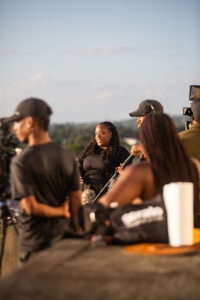
We had £93k for the production from Lankelly, and that’s been really helpful to start something. We did a first period of filming in the summer of 2023, hired a local crew as well as a producer in London. Then we did another block of filming in November 2023, around Independence Day in Barbados, and we were trying to pick up Independence Day celebrations and Crop Over tourism celebrations in the summer. It really enabled us to be able to pay for all of our crew, equipment, everything we needed in order to at least get the raw film ‘rushes’ and start the process with an editor.
I think we’re in a good place at this moment in time, and that’s really been the impact of Renee trusting and believing that this work was important when so many others were telling us that we had to make it more dramatic and move away from the voices of people, to something that focused more on White people trying to understand Bajan culture.
It’s been very difficult trying to bring together a film when we’re so used to an industry of film that is exploitative and colonial. That also means that sometimes you hire people who are still holding those things. So it’s been really difficult to fundraise, to continue to believe in projects, to manage people and their insanities and what they bring into a project.
My relationship with Renee has been amazing. I’m very grateful to have her support throughout. Renee was also part of our second block, so came to Barbados to see us, and was very helpful in terms of mitigating conflicts and things that were happening on set because of different personalities. And so yeah, it’s been great working with Renee on this and also just having her belief and physical support.
Understanding the root causes of colonial manifestations
I don’t care about whiteness. I don’t care and I have no time for the disposition of benevolence that exists within the colonial structures of foundation and grant making in the UK. Because of that awareness, and because all my work has always been focused on understanding the root causes of colonial manifestations today, it’s very clear for me to see how that exists in the foundation space. So an active choice is for me not to engage with that in the way that it expects of me […] I’ve worked in different organisations, and organisations are just made up of people.
I’m very used to understanding the anxieties that people have when it comes to considering Black people as human beings. Those things aren’t new to me, so I navigate with that in my pocket and in my psyche.
My organisation is set up as a private limited company, even though a lot of the work that we do, people consider as charitable work. We set up a private company knowing that our work is going to support Black curators to do this, or be in films that support people to be paid fairly whilst working on them. It’s very intentional.
I’m also Muslim, and I think a lot of how I’ve been raised has focused on a duty to share, a duty to open up space, and a duty for your money to be put into community development.
So for us to get foundation support is sometimes another conversation […] I refuse to be beholden to the UK Charity Commission’s legislation because it’s racist, and racist in a very guided form, which I think a lot of people don’t understand as racism or classism or sexism or homophobia, and various other isms and schisms.
I’m always going into working relationships with foundations from a space of autonomy, from a space of: ‘We do this, if you want to fund us you do. If you don’t, someone else will.’
Making money move
I want to see money move. I want long-term money to move. I’m tired of little pieces of money being thrown at Black organisations. That isn’t what creates long term change.
I want to see money move in the same way that it might move in the States, or it might move in terms of 10-15 year commitments to work, instead of one or two. We’re not going to see cultural change over two years. It’s not going to happen.
I also want reparations. A lot of that benevolence money needs to go back to the Caribbean. I’d want to see people’s money actually talking, not from a space of fear, but from a space of, ‘We fucked up’. More money is owed to the world because of how foundations have built the resources that they currently have.
That’s what I’d like to see – long-term investments and reparations.
In the UK I’m not seeing any movements in this direction. It’s actually shocking. I feel all of the foundations who were doing that work are now closing. If the people who ‘get it’ then absolve, it’s just everyone else who is left who weren’t progressive in the grant making space.
It’s exciting to see Lankelly having these conversations. It’s been really interesting to see Lankelly choose to close because of the conversations around benevolence. Whilst I know there are multiple conversations about, ‘If they’ve finally got it, why have they disappeared?’, among some people who were really excited at Lankelly doing and beginning to live the work.
The best thing that could happen
The best thing that could happen if money starts to flow is that we deal with the impending mental health crisis that is destabilising a lot of communities.
The documentary is about climate crisis, and I would like to see reparative solutions for what’s happening in the Caribbean because of colonialism. I would like to see money flowing in that direction to support people to survive what is going to come.
That is the positive for me – that the mental health crises that are destabilising a lot of people out of action is addressed, and that the reparative futures for spaces that were so deeply exploited over generations are given the space to breathe, thrive and survive climate catastrophe.
It is an everyday reality in Jamaica, in Barbados. It feels farther away from the UK because we get a couple more hot days in September and October, but money needs to flow into those spaces for all of us to survive.
Story Weaving by Jack Becher
Learn more about Generative Journalism Alliance