
Philanthropists face existential challenge
Fundamental rewiring needed
By Andy Crosbie
Humble beginnings
It has been a fascinating experience working with Lankelly Chase.
Lankelly offered funding in a way that I’ve not seen any other funder offer it, with a genuine commitment to partnership and a humility that I also haven’t seen anywhere else.
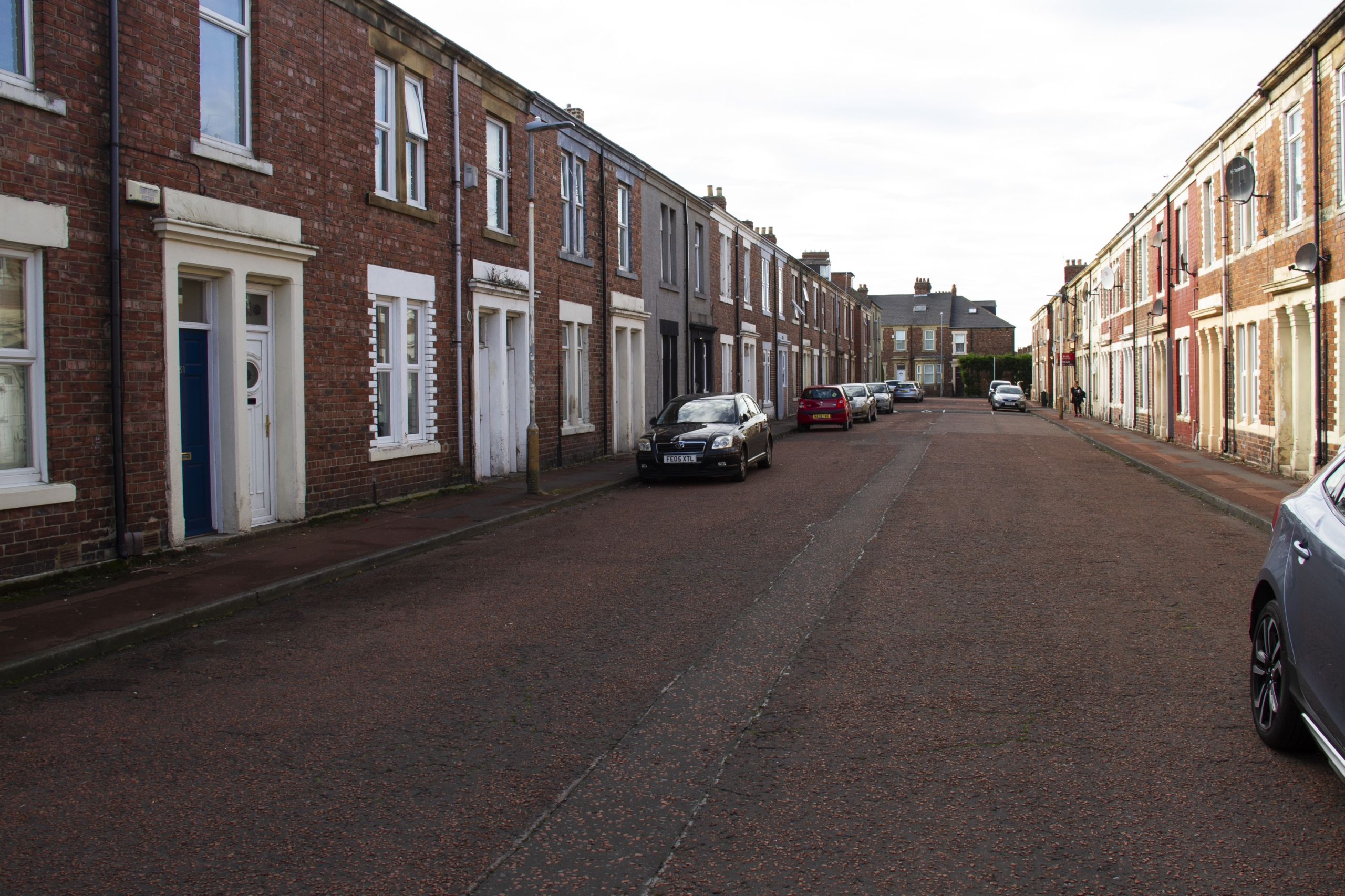
I’m based in Newcastle, Gateshead, partnering with Lankelly as part of their place-based work.
This started in early 2020. We’d been working with Lankelly for about six months at that point, and Lankelly’s starting point was that they didn’t think a small foundation based in London with no knowledge of the North East should make decisions about what happens to money on the ground in Gateshead. That’s why they insisted on devolving decision-making locally – an amazingly humble approach for a funder to begin a relationship, and look at what’s been made possible.
We have a team of ten community Bridgebuilders – regular people from marginalised communities across Gateshead who are well connected within their areas. They’ve been working as bridge builders for three years, drawing on existing relationships in their communities to enable local decision-making. Three weeks ago, we celebrated nearly three years of this work.
When we started the bridge builder idea, we believed that people in communities know what’s best for themselves, but none of the existing structures really enable that. When we began the bridge builder work and brought in local people to take on that role, it was really hard because nobody was used to local people making decisions. We received a lot of criticism and animosity from existing power structures who thought we were doing something stupid at best, dangerous at worst. That first year was really hard.
Somebody observed that if this work had been funded in the usual way, there would have been a report after 12 months that looked like a failure and the money would have been cut off. It took two years before any green shoots appeared as proof of the faith we had in this, and then a third year before we really began to see its impact.
One thing I take away from that is the importance of giving these initiatives time to grow – the importance of maintaining faith in good ideas, even when they attract criticism.
Unintended consequences
I’ve actually built quite close relationships with people at Lankelly. It was fundamentally a supportive relationship – in no way was it a monitoring relationship, which, between a funder and a grantee, is pretty much unheard of. I’m very grateful for that.
With all of the things that Lankelly have tried to do differently, I think there have been a number of unintended consequences. One very practical, operational issue has been actually getting the money out of Lankelly. The realities of moving their money from A to B have all got jammed up in Lankelly’s systems. That’s been a regular and repeated frustration.
A second frustration is that, although we’ve had this relationship of devolved decision-making for five years now, it’s always been based on an annual budget process. That gives very little security to the people in the community doing this work.
It’s also been quite fascinating to see that, while the nature of our relationship with Lankelly has been very good, Lankelly have not been very good at actually sharing the relationships that they hold.
When I started this work, there were six places involved, but that quickly dropped to five. Lankelly is funding these five places around England in the same way, yet they haven’t actually introduced the places to one another. One of the things I invested a lot of time in was connecting the places because we’re doing the same thing in different areas – or our own version of the same thing – and there’s so much learning and support to be found there. I don’t think Lankelly have ever been very good on the learning side of this.
Pushed away
Lankelly made a public announcement about 18 months ago that they were going to redistribute their assets.
We had a very good, supportive, productive working relationship, and then they made this bold, momentous decision, saying we’d go through it together – and then we haven’t gone through it together. That makes me sad. I understand how hard it has been for them, but the things they care about and are trying to do are things I care about and would have liked to contribute to. It has felt like being pushed away.
On the one hand, they’re making an incredibly bold statement about the state of philanthropy, about what needs to change in terms of power structures and money structures, and I think their analysis is very strong. From a local perspective, it’s really scary because they’ve made possible things that probably no other funder would have ever made possible. The question we’re actively asking at the moment is whether our work will survive after Lankelly ceases to exist – we don’t know the answer to that right now.
I feel that the bold move Lankelly has made could have had a massive impact on the UK philanthropic sector – if not wider – but from where I sit, I wonder whether what’s going to happen is that Lankelly will close and a number of exciting, innovative things will stop because nobody else will continue them, and Lankelly will just become a footnote in history. I’m even concerned that Lankelly might serve as a cautionary tale to other funders rather than an inspiration – the opposite of what was intended.
Holding power
I spoke about the trust and humility that Lankelly showed very early on. I would love to see other resource holders imitate that. One of the wonderful things about working with Lankelly was it never felt controlling. Lankelly always worked very hard about how they showed up and how they held their power.
I would love to see Lankelly influence other resource holders around moving away from control, moving towards trust, devolving decision making to people who have been excluded from decision making. We know we will not find another funder who will fund the bridge builders in the way Lankelly has. What we’re trying to do at the moment – it’s very early in the process – is to set up a pooled fund. We essentially want to create the same sort of fund that Lankelly enabled, where Gateshead people are the decision makers, but with multiple funders sharing the risk.
We think that the fact Lankelly has blazed the trail here might be enough to encourage funders to take on part of the risk, but in conjunction with others, thereby easing them into this different way of doing things.
Challenges and goals
One of the big challenges that we have is resource amassed in particular places, with small groups of people at the top in charge of this massive resource. That structure is always going to be a problem.
If we’re talking about philanthropy, if we’re talking about trusts and foundations, the very identity of a philanthropic institution is that we’ve got a big pot of money and we decide what to do with it. If what we’re saying is that we think that that structure is a problem, and we’re actually saying to trusts and foundations, ‘You need to devolve decision making to a wider group of people,’ then that presents two really fundamental challenges to trusts and foundations.
The first is if we’re saying to trusts and foundations, ‘you need to devolve decision making,’ there’s a deep question of identity there. ‘If we’re not making decisions about this money anymore, what is our identity as a foundation?’ An identity has really deep roots, and I think that’s been part of Lankelly’s journey these past two years as well.
The other challenge that it poses to trusts and foundations is an existential one, which I think Lankelly has already demonstrated by the steps it has taken.
What I believe is needed is a fundamental rethink and rewiring of how society operates and is structured. I think this is an existential issue – our current system is destroying the planet and all of us with it.
If we’re going to make the radical transformation that is needed, philanthropy has a really important role to play, to catalyse and jump-start that change.
What’s the best thing that could happen? That we could unify all of those progressive actors trying to pull in that direction, so that philanthropy could unite and share the wealth it’s holding in very different ways to how it’s currently being distributed, enabling a coming-together like we’ve never seen before. Then we could start that fundamental rewiring, changing the way society is structured into something much healthier and more sustainable.
Is that possible or realistic? I don’t know, but if we’re talking about the best, let’s reach higher.
Hosted by Tchiyiwe Chihana. Edited by Maryam Jameela
Learn more about Generative Journalism Alliance