
Philanthropy’s future tied up with wealth inequality
Massive public policy agenda barely off the ground
By Jane Millar
I started as a trustee in 2013 and was there for about seven years.
Lankelly approached me, and asked if I was interested in becoming a trustee. I was interested in what they did in relation to severe and multiple disadvantage which was the focus at the time. They approached me to help with the research side of things because that’s my expertise. They wanted someone on the trustee board that could advise them on research, on methodology, on how to do evaluation, stuff like that.
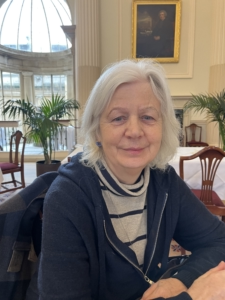
One of the things I really liked about being one of the trustees is that it was quite a diverse group of people. It was so nice to be working with people from different backgrounds and different perspectives. Actually it was my first time being a trustee, so I learned a lot about the trustee role and what it means for a trustee and how you work. It was a balance between working with the people who are actually running it, and your role as trustee in terms of ensuring that they’re fulfilling charitable objectives and so on.
Balance
There was a lot of discussion at one point about: what did we expect of organisations that came to Lankelly Chase looking for funding support, what were the issues and questions, how appropriate was it for us to be putting them on the spot and asking questions about what they were doing?
There was an interesting debate about: how do you effectively support organisations and ensure that they’re doing what they’re set out to do, but without trying to manage them or change them or do things that isn’t the way they see it? That potential tension, between being a funder who wants to see things happen and being an organisation that wants to get on with what you want to get on with, can raise some issues.
Along the journey there was ongoing concern or issues in two areas – one about investment. So we’ve got all this money – how ethically can you invest it when you’re an organisation like that? That was a long debate. And then also about the nature of the trustees. How do you make a trustee board that is more diverse, has more of a range of voices and includes lived experience voices much more directly in the whole process of managing an organisation like that?
People were willing to dig away at issues and keep being persistent on them so the trustees made a commitment to making them work. From the senior management side there was an open desire to see things changing. It wasn’t always a meeting of minds, but there was a kind of meeting of intent. There was a lot of respect, I thought, in relation to people feeling able and open to raise issues and then for there to be debate about them.
Existential questions
The whole direction of moving to close was a major, significant change that happened after I left. This developed, I think, from discussion about: what does philanthropy need, how can you be a philanthropic foundation, and how is it possible for an organisation to do this in a way that addresses the power imbalance?
The closing did surprise me, because not many organisations do that. I could see logically where it followed from the debates and discussions and the way in which the issues had been addressed. But I was surprised because not many organisations shut themselves down unless they have to. I see that as a positive decision and a positive way of stepping forward.
The future of philanthropy is tied up a lot with the whole question of what we do about the vast inequalities in wealth. We are in such a terrible situation in terms of how much wealth has become concentrated and what that means. I think there’s a massive public policy agenda that’s hardly got off the ground yet in terms of wealth. Of course, one of the defences of wealth is philanthropy, but the role of philanthropy is itself open to criticism and disagreement.
How – if we ever can – are we going to tackle those inequalities in society? How far are we prepared to accept that some people will not only have so much resources, but use them however they like, to whatever detriment to the planet or inequality or health, and so on? It’s both having too much resources and using them in ways that are bad for society. I think we need to get to grips with these things.
Wider context
I think that the wider context of what Lankelly were doing is quite something. When I first started with Lankelly, it was more like, ‘Here’s this project – how does it work? What’s involved?’ But over time, it’s become about having a wider context.
You have to be there, doing the things you’re doing as a foundation – that’s essential. But being aware of a broader context, the wider issues and debates, is really helpful.
I’m sure trustees in other organisations aren’t completely closed off to these things either, but it’s about thinking through how you sit within that ecosystem. What are you contributing to inequalities and difficulties, at the same time as trying to address them in one place?
I thoroughly enjoyed my time at Lankelly, and I also felt that Lankelly was doing very good and worthwhile things, opening up areas of debate and sparking interest in important issues.
We focused a lot on philanthropy, which was valuable, but I think the work on severe and multiple disadvantage was very significant. We’re in a situation where so many people are living in extremely deprived and difficult circumstances. Understanding how people end up in those situations and figuring out how to help them is absolutely crucial. It’s such important work, and I really hope it continues in some form. I do hope foundations continue to support that kind of work as well.
Story Weaving by Tchiyiwe Chihana and Maryam Jameela
Learn more about Generative Journalism Alliance