
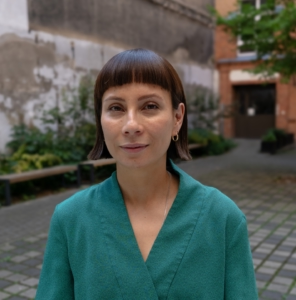
Process as politics in practice: Rose Longhurst
Building accountability to the people on the sharp end of creating change
A Lankelly Legacy Interview. Hosted by the Generative Journalism Alliance
Rose, could you start off by telling me a little bit about your relationship with Lankelly Chase?
I first got to know Lankelly Chase around 2015 through the facilitation group of the Edge Fund – a UK based fund that funds grassroots groups fighting injustice and inequality.
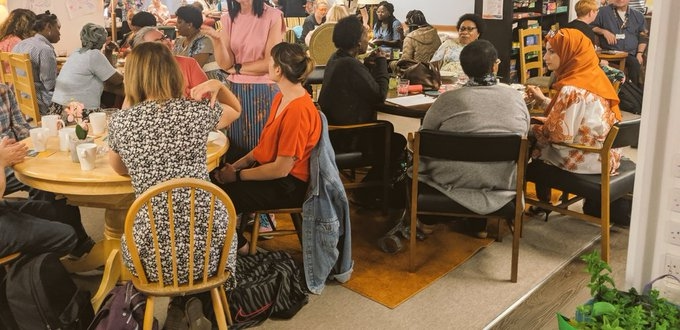
When we set it up, there was a volunteer collective that would run it, and I was part of that. Habiba from Lankelly joined Edge Fund and invited us to come and meet her at the offices.
Since then I’ve had lots of contact points with them. I engaged with Lankelly Chase with three different hats on: Edge Fund, Fund Action, and the EDGE Funders Alliance.
It’s very confusing. I’m involved with too many things that all have the same name.
But all of them share a very clear politics about needing to dismantle the systems of oppression that have got us into this mess, and philanthropy is inherently part of that.
More recently, Lankelly Chase got very interested in participation and alternative forms of decision making. Through that they wanted to learn more about Edge Fund and Fund Action, which I helped to set up back in 2018.
And before all that, actually, around 2014, I had met one of Lankelly’s board members, Jake Hayman, who was one of the first people I was aware of who really was an outspoken critic of philanthropy in the UK. He sparked an event in Oxford, run by a group called Marmalade, which I was invited to. I was really impressed, because Jake was one of the few people in philanthropy who actually seemed to critique it and talk about it in a way that resonated with me.
On the whole, how was it for you being in that relationship?
It was a very ambivalent relationship.
On the one hand, I think many people at Lankelly Chase have done a lot to support and champion our work, and done a lot of thinking about systems change.
But how much of the critique of philanthropy actually turns into something practical and tangible that benefits the people on the sharp end trying to create change?
The way we envisage systems change at Edge Fund, EDGE Funders Alliance and Fund Action is thinking about the systems of oppression that underpin many of the problems that the world is facing – hetero-patriarchy, racial capitalism, extractivism and all these things that are both really theoretical but also fundamental to the way we live our lives every single day in every relationship we have. That is the systemic change we need – new economic systems, new social systems of care, new political systems.
Whereas Lankelly Chase looked at it from a much more technocratic perspective, rather than actually really questioning the systems and structures of domination that led to philanthropic wealth hoarding and people being in positions of power.
Maybe that has happened more recently, but in the decade or so that I’ve worked with them, a lot of the time they’ve ended up listening to or working with other highly educated, smooth-talking folk that use language not necessarily used by people on the front lines.
I get more and more conscious of this the older I get. When I first engaged with Lankelly I was a feminist activist, part of collectives, living precariously, and that is not my situation anymore. The further away I’ve got from the people on the front lines that are actually fighting and trying to do things differently, the more conscious I am that I need to step back, be quiet and listen to them. It’s not my fight in the same way anymore.
I often see myself as playing a translator role between funders and the grassroots groups who are living this on a day to day basis – struggling, fighting and trying to create new ways of living and being.
In my interactions with Lankelly Chase, we would have repeated meetings where we would go and talk to them or present or write blog posts or be highlighted by them as an example of doing things differently. But when the rubber hits the road in terms of actually redistributing funding or copying our practices and funding the groups we were funding, it just never manifested.
So when they made this announcement [to redistribute], I thought, ‘Wow, that’s really, really cool. They’re putting their money where their mouth is. They’re really making a bold statement here’.
But then I attended one of the events where they were telling people about it and it felt like, ‘Oh, you’ve got an announcement, but not a plan’. I could understand they wanted some time to think it through, but it rattled folks.
What would you have liked to have seen?
I deeply believe that wealth should be redistributed in as democratic and participatory and pluralistic way as possible. So I think Lankelly should’ve done just that by giving their wealth to participatory grantmakers, autonomous spaces and other spaces that are run democratically and benefit multiple causes. That would’ve been really radical.
I would’ve loved to have seen Lankelly come out and say what they were going to do with their money, and who was making decisions about where the money goes, and how those decisions were made.
At the end of the day, that’s all that I really care about.
I would’ve loved an outline of a process of what they thought that was going to look like that was informed by the politics of redistribution of power, rather than vague proclamations about needing new economic systems.
That might sound rich coming from someone who spends a lot of time talking about new economic systems and not knowing what they look like, so I don’t want to say it’s easy.
But they perhaps shouldn’t have made an announcement before working out some process.
To me, politics and process are so intermingled – the process is your politics in practice.
It sounds boring, but it’s where your actual lived politics are.
Oftentimes, and especially when there’s not clear communication, systems and processes, that lack of clarity and transparency can open the door to a lack of trust.
I think the good will and trust was very strong, but what you need is clarity for accountability.
There needs to be clear accountability alongside requests for trust. If you’re saying, ‘Trust me, I’ve got your best intentions at heart’, or ‘Trust me, this is going to work out’, then who are the people who get trusted? And who are the people who don’t get trusted? Who are the people able to be legible as worthy of trust in the ecosystem? And who are the people you would be suspicious of?
If you’re saying, ‘We’re going to make strides to become an anti-racist organisation and trust us that it’s important to us’. That’s great, but it would be better to make strides to become an anti-racist organisation by doing ‘this, this and this’, by these dates, and investing this much money in it. And saying ‘This is why we’re doing it and how you can tell when we’ve done it’.
Box ticking sounds terrible, but that is where the accountability comes in. I think you need both. I think you need relationship building, and I think an over reliance on relationship building benefits certain types of people.
That wasn’t necessarily just about Lankelly – there’s a general over reliance on relationship building as a mechanism for justice in philanthropy.
Thinking about the wider philanthropic field, what do you suppose the learning from this experience might be?
I really, really hope this goes well, because I hope others will follow the example of Lankelly Chase.
Even if they’re not spending down or sunsetting or whatever they’re calling it, just reminding folks that that is possible and doable and admirable, I think is really important.
I don’t think this conversation would have been happening when I started out in this field 10 years ago.
One of the things I always thought was strange when I started learning about philanthropy is the way that foundations would say, ‘Well, what’s your sustainability plan?’ Or, ‘How are you going to grow?’ I always used to think, ‘Well, we want to win. We don’t want to grow. We want to end violence against women, or whatever it is, not get a bigger organisation. That’s totally not the point’.
I would love it if what Lankelly did made other people question some of the underpinning ideologies or myths that underpin philanthropy. Like, that social change is done in a certain way, and that you have to fund charities that are providing services, rather than actual systemic change or political change, or power building or community organising – the shit that actually needs funding.
If they can shift even 10% of the money that’s sitting in banks all over that would be absolutely fantastic. Even if they’re shifting it to shit that I don’t think is that important, I’d rather the money was out of the banks and circulating, doing something, even if it’s not something I agree with, than just sitting there.
Hosted and edited by Jack Becher
Learn more about the Generative Journalism Alliance