
We need radically different futures
We cannot rely on our public institutions
A Lankelly Legacy Interview. Hosted by Generative Journalism Alliance
Malik, can you say something about the work you’ve been doing with Lankelly Chase?
I think part of the challenge that we have – that Lankelly has had in funding and supporting groups in the UK – is that we’re up against historically racist, colonial, empire organisations now operating in a new way. But they’re essentially the same organisations and institutions and ideology that led the Atlantic slave trade, and that then went into a long period of violent and brutal colonialism. It’s the same mentality and ideology that is running our organisations today, but disguised in a much more advanced form as neoliberalism. But it’s the same people.
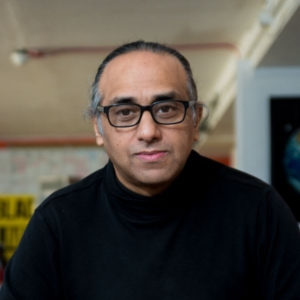
So Lankelly funded us. I kind of feel that what Lankelly has attempted to do over many, many years is to invest in sites of resistance, in areas of gender, or anti-poverty, or housing. Our site of resistance is mental health. We’re all trying to tackle and address oppressive regimes.
In our mental health wards, if you are from Black and Brown communities you’re four or five times over-represented in the wards. At Springfield House Hospital, 60 to 70% of the people on the wards are Black, yet the population is only 14%. It goes throughout the whole mental health system, from early intervention to wards, coercion, Community Treatment Orders – fundamental discrimination and oppression of Black people.
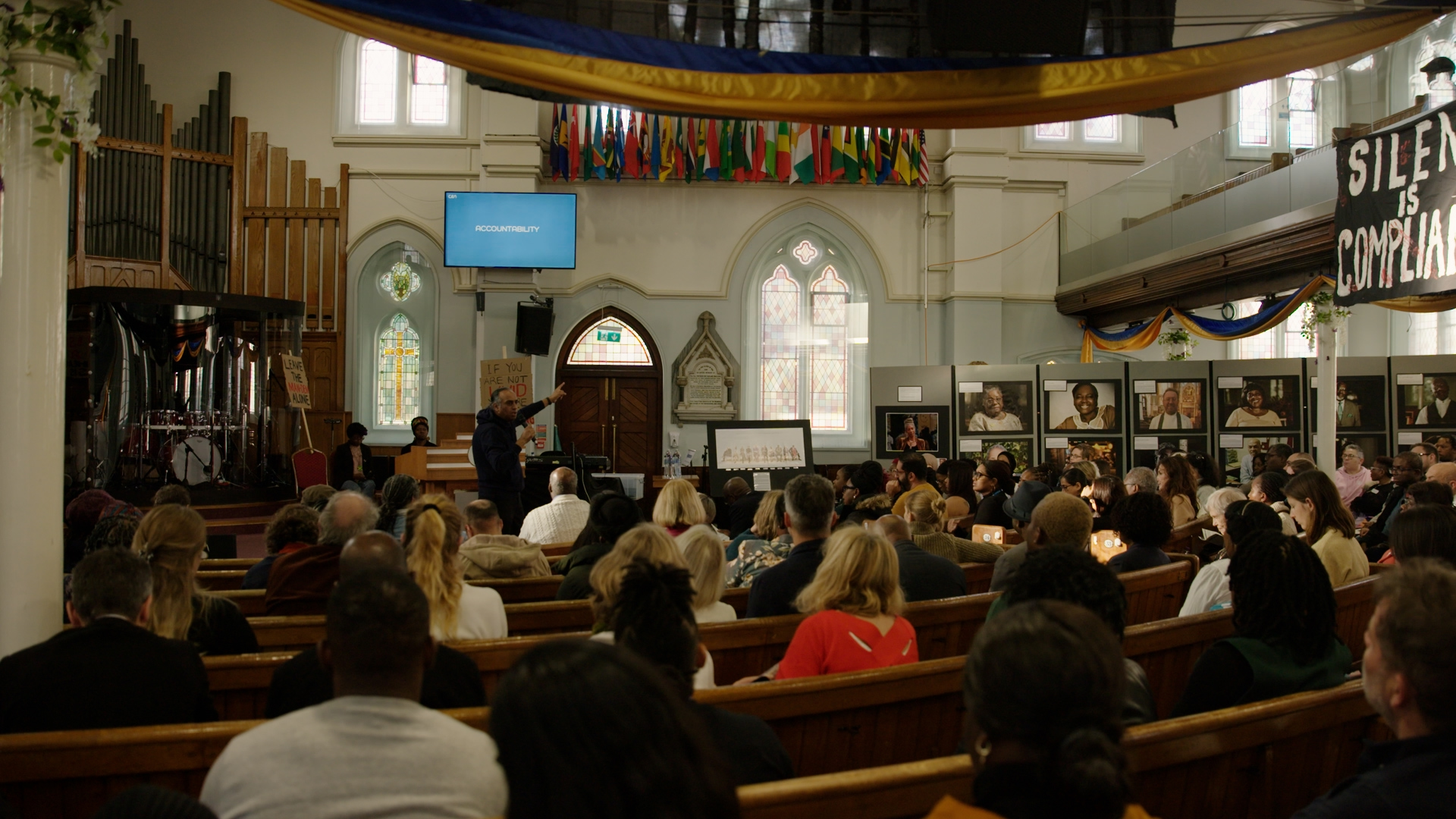
So our work, which Lankelly funded, is about whether we can develop alternative sites of mental health intervention. Because people need care, people need support. We’ve developed a programme called the Ethnicity and Mental Health Improvement Project (EMHIP), which Lankelly have funded and supported. Can we have sites like this church, which I’m currently in, or other sites of association where people already gather and feel safe? People already come into this church and see it as a sanctuary. They identify with the people at the church, and because they look like them and talk like them, they feel comfortable here. Mushka, which is our partner, is a South Asian organisation run by Muslim women. So other Muslim women go to that place because they feel safe, they feel comfortable, they feel understood. Now, in these sites can we develop radical alternatives to the mental health hospital? That is the project that Lankelly has funded and supported.
I’ll tell you the big lesson that we’ve learned. Our mental health institutions are the ones who are legally obliged to care for people – our NHS. Therefore, if we are developing these radical alternatives, to care for people in ways that people want to be cared for, and to reduce race disparities, we should ideally co-produce this with the institutions that are legally obliged and funded to do so. That’s the way it should work.
One of the biggest and most profound lessons that we’ve learned is that our public institutions are not for changing.
They talk the language, they make the pledges and the platitudes. You’ll remember the Black Lives Matter movement, 2020, and how all these institutions came out in force. ‘Oh my God, we didn’t know this was happening. Oh my God, look how bad it is’ – you know, the blackouts on Twitter. But fuck all has changed in those four year periods.
What we’ve learned in trying to implement the EMHIP program is that our public systems are not for changing. They’re not going to bring about the radical transformations that our communities need. They simply ain’t gonna do it, they’re not built to do it.
They are not built and designed to be transformational organisations – they’re built and designed to maintain the status quo, the silos, the bureaucracies, the administrative controls. They are not built to transform, they are built to sustain.
And of course the legacy of colonialism, which Lankelly quite eloquently talks about, goes back 500 years. So that has been a really painful experience for us over the last four years, because we threw our lot in with them. I often kick myself because four years ago, five years ago, many of our colleagues who are more long in the tooth said, “Malik, don’t do it. You know what these institutions are like, you know they’re not going to change and transform, and you know they’re going to bury you”. But we live with hope in our hearts, you know? We live with optimism in our soul that we can build better futures, that we are better, collectively and individually. We are better than we are painted out to be.
So we threw our lot in with the local Mental Health Trust, and we have experienced violence from them. We have experienced brutality from them. They have talked to us about how they really care about Black and Brown poor communities, that they care about injustice, that they care about bringing about change. But they don’t give a fuck.
This is how they treat vulnerable, at-risk and poor members of our community. And I don’t want to believe that they do this consciously. I want to believe that they themselves are also victims of the system and of the structures. I want to believe that they are also experiencing violence from the system, but for whatever reason they lack the appetite, the courage and the will to do something about it. They also are victims of the same system that we are victims of.
Where we are today is that we’ve realised, and I think Lankelly Chase have also realised, that we’ve got to have radically different futures. We cannot rely on our public institutions. We’ve got to hold on to the fact that we are the many, and that we do believe in better futures and that those better futures will come.
What has been made possible through your work with Lankelly that wouldn’t have been possible otherwise?
Fundamentally, independence. That’s the biggest thing Lankelly Chase gave us. They gave us independence, and they gave us funding and resources which enabled us to do what we believed was right. And they gave us that funding with no strings attached, which is very, very rare. They didn’t say to us, ‘We want this outcome, this output, this KPI’.
They said ‘We believe in what you’re doing, here are resources to enable you to do it’. That was brilliant, because we were then not reliant on institutions and others to tell us what to do. We were able to come to them with independence and power.
We would not have been able to do our Ethnicity and Mental Health Improvement Project if we didn’t have that, if we weren’t able to come to the table as equal partners and say, ‘Okay, what money have you got? We’ve got this money. What are you bringing? Because we’re bringing this’. That’s what it gave us – independence and strength. And it gave us power, because we weren’t coming to [NHS Trusts] for money, we were coming to them for co-production. That’s what Lankelly gave us.
The second thing they gave us, and I’ll never forget this, and I’ll always be thankful for this, is that when we were negotiating with the Mental Health Trust and our local partners to deliver our projects, [Lankelly Chase’s CEO] Julian came to those meetings with us. That was a profound act of solidarity. Lankelly Chase didn’t have to do that, they could have just said, ‘Here’s the money, go away’. But Julian got into the trench with us, and I will never forget that legacy. I feel very emotional about that, because it was an act of generosity and friendship that I’ve never seen. It gets me emotional because he didn’t have to do that.
What that did is that made us feel powerful, because we were no longer a small charitable organisation. We were now with this relatively big philanthropic organisation that was willing to stand next to us in our hour of need. That fundamentally shifted the ball game. Not only did that make us feel powerful and strong, it made our statutory partners take us seriously.
They’d say, ‘Oh, you’re no longer this small, little Black charitable organisation who’s kind of nipping at the feet of our big institution. You are now standing with this big organisation who are willing to invest in you’. That then enabled them to invest in us, and they gave us something like £800,000, £900,000 to develop our EHMIP programme.
The problem with that is they [the Mental Health Trust] set us up to fail. Because they gave us the money and said ‘Get on with it’. Now, fundamentally, you can’t change the trajectory for mental health like that. You can’t say ‘Here’s £500,000, go away and get on with it’. No, the Mental Health Trusts, just like Lankelly were, need to be in this with us.
So we got the money. But the problem that we’ve now got is that we’ve realised after four years of practice that the systems are not going to implement what they say they’re going to implement. They just don’t have the appetite, the will, the leadership, the capability to do it.
So we’re now at a bit of a crossroads, where we’re going to have to fundamentally redesign that programme. We’re going to have to genuinely run radical alternatives. It’s the place that Lankelly Chase has come to – we just can’t keep doing the same old, same old. So we can get £800,000 next year, and keep doing that for the next 20 years, but that’s not going to provide the transformative future that we want in mental health.
So we’re now back in a very difficult position, because we’ve stuck to our principles for four years and while we’ve tried to work with the Mental Health Trust, we’ve still got our red lines. And what’s happened, again through the legacy of colonialism, is that they’ve basically shut the doors to us. Basically they’ve said to us, ‘We’ve given you all this money, how come you’re not playing ball? We’ve given you all this money. How come you’re not singing our praises?’ We’ve stuck with our red lines and we’ve said, ‘No, you’ve given us the money, we’re trying to work this through. This is not two, three year work. This is 10 or 20 year work. It takes time to do this’. We’re not going to take that money and then stay silent on the things that are not working. And what’s happened is ego and power got the better of them, and basically they’ve turned around and are using their power now and saying, ‘We’re not going to fund you anymore, we’re going to fund other people’. So we’re in a profoundly difficult situation now, and we’ve got money until the end of the current financial year, but we’re going to have to fundamentally rethink how we do our work.
Thinking back over the time that you’ve been in relationship with Lankelly Chase, what would you have liked to be different?
I think that Lankelly Chase has been admirable in funding lots of different things – I don’t know, 50, 100, 200, 300 different initiatives. They’ve kind of let a thousand flowers bloom. I think as a charitable foundation that is what they should do, and that is what they’ve done.
But looking back, I think funding five or six things at scale perhaps would have created a greater impact than funding 100 things.
Looking back, in hindsight with the magic wand and all that, I think doing that would have been a better gambit. Having five or six sites of international excellence, because you’ve put £20 million in each, would have been a better gambit. Because, for example, we got money from Lankelly – I’m going to take a wild guess, around £300,000 or £400,000. If we got £10 million, I would be on the phone right now talking about bringing about profound change.
I think part of the challenge with Lankelly’s legacy going forward is that with all these projects Lankelly have funded, there’s a big question mark in relation to their sustainability and their ability to have impact in the systems that they’re working on. Because, of course, the systems that they’re working in are up against neoliberal institutions. I think we only shift and move those institutions by huge investment.
I would like to know, with Lankelly making this move [the redistribution and closure], how many other institutions and charitable foundations will do the same thing? I fear not very many. I recall Julian at the time, making the statement, saying that one of the intentions is that other institutions, other foundations – that they may do a similar thing. Now, if that was the case, we have a paradigm shift. But I fear that many won’t, and that then puts us back in the conundrum of, while we’re giving away this money, where are we giving it away to, and how are we giving it away?
My wish is that Lankelly identifies six big initiatives and funds them. Because I think that if we’re taking on a mental health institution, our local one here has £760 million. To take that system on, you need £20m, £30m. You’re not going to take it on by giving us £500,000 because the opposition force is so big.
How can we develop a system, a networked mental health system, and invest in that? That’s going to require £10 million.
What is it that you think still needs to shift in philanthropy to enable your field to flourish?
At the moment I think people make change. But we want to get to a situation where systems make change, and processes make change, and we’re not relying on individuals to do it. Where the processes and the systems and the structures generate and sustain and embed change. I don’t think we’re at that place yet – I still think we’re at a place where we need courageous leadership. So there’s something really profoundly important within these other philanthropic organisations: how do we identify these individuals? How do we coach and mentor these individuals? How do we bring these individuals together and support and enable and coach and mentor and encourage and cheer them on?
This is courageous work. For an individual on Joseph Rowntree’s board, for example, to say, ‘Actually, we should be doing this. We should be doing what Lankelly Chase are doing’. That is an incredibly isolating thing to say and do. That is an incredibly lonely place to be in, because the chances are that the other people on the board are not thinking how you’re thinking. The chances are also that the other people on the board are actually a bit comfortable. They like doing what they’re doing because it gives them a bit of power and control and prestige: ‘I’m on this board, look what I’m doing, I’m helping people’. And for somebody to get up and do what Lankelly are doing is an incredibly dangerous thing to do – dangerous in a good sense, because we need radicals in this space to do good and dangerous things. I don’t think that our systems and our structures and our philanthropic bodies are ready and willing to do that. In fact, we know they’re not willing to do that, because they all would have done what Lankelly has done.
We know that there are people in all of these institutions, in all of these bodies, who are thinking the same way Julian’s thinking. But they know that it’s a risk and isolating and vulnerable for them to put their head above the parapet. So therefore how do we encourage and support them? How do we bring them together? How do we have these conversations? This will be an important legacy of what Julian’s doing here.
How does Lankelly think about that quest, about supporting these individuals, about building a movement with these individuals, about bringing these individuals together? Because it is individuals, I don’t think it’s institutions. It’s individuals on boards. I know a lot of Mental Health Trust boards, and non-executive directors. And what’s really interesting is that when you speak to individual non-executive directors outside of these board meetings, they all agree with you. They all turn around and say, ‘Well, absolutely Malik, you’re absolutely right. We need to do this. It’s not good enough’. But once they get in the board meetings, groupthink is the institutional default. I don’t know whether this is a question of courage or leadership, I’ve got to think about it a bit more. We’ve got to find those individuals, and we’ve got to give them courage. We’ve got to say to them, ‘Yes, this is what we need to do’. How can we support you? What do we need to do? Where are the movements? Where are the training programmes, the mentoring, the coaching, to find those individuals and get them going on this path?
What steps, if any, are you already taking or willing to take to bring about that change?
Part of the challenge that we have is that it’s very brutal. It’s very violent on the self, because you’re taking shots – you’re getting hit and hurt all the time. You know, my own mental health, and we often hear of people being burnt out, exhausted, tired. So the question about what more we can give is really a difficult question, because I feel tired, exhausted, hurt. I know a lot of my colleagues and friends feel the same way. So for us to keep doing the work, there’s something really important about how we look after ourselves, and how we look after the people that are around us.
What more can I do? It’s within my nature to keep wanting to do the work, and I will keep fighting, but unless we look after ourselves… that’s why I feel very emotional about Lankelly and their work with us. Because unless we feel that others are standing alongside us, unless we feel that I’m going to go in and meet the Mental Health Trust, and say ‘We are not going to shift. We believe profoundly that there needs to be a fundamental shift in what we’re doing, and you as legally responsible bodies need to invest in this’, they will come for me. We need people to stand alongside us. That’s why I think Lankelly needs to make choices and decisions.
They need to say ‘We recognise that all of these things are important, we recognise that all of them have equal value, we need to fight all of these struggles. But we have to make a choice to say we’re going to fight on these five fronts, and we’re going to throw our lot in behind these five fronts’. If we can get three of those over the line, that will be fundamentally transformational in whatever area Lankelly chooses to do that. I think that’s how we’ve got to do this.
Zooming out and thinking ahead to the future, what’s the best thing that could happen?
Look at our local Integrated Health System – £3.5 billion. It doesn’t need £3.5 billion to run, it probably needs something like £2 billion to run hospitals and all of that.
Can you imagine if you shrunk that institution and gave that £1.5 billion to community organisations around southwest London to develop people-based, human-led prevention and early intervention?
It would transform health services with that £1.5 billion fundamentally. So I think that if you ask me what a good future looks like, a good future looks like reduced institutions, small institutions.
We don’t want big institutions. That’s the problem – we’ve got bloated, massive institutions that are running massive debt. What we want is reduced institutions and more money redistributed to community-led organisations.
But the problem we have is that the infrastructure for community organisations isn’t there. Just look at Lankelly Chase’s funding portfolio. In all of the organisations they’re funding, there’s probably another five or six organisations like them in the same areas. So let’s say a children’s charity in York – there’s probably going to be ten children’s charities in York. Let’s look at my organisation, there’s probably, off the top of my head, another 10 or 20 organisations like me in southwest London. Why have we got ten organisations? Why have we got five charities?
There’s just too many. What we should do is have mergers, collaborations, partnerships. Don’t fund ten organisations – fund one organisation to bring ten organisations together. Fund one children’s charity in York to bring the other five charities together. We’re only going to do this Jack if we do it at scale. We need to be funding ecosystems: a Black mental health ecosystem, a housing ecosystem. Let’s have more mergers, more partnerships, more ecosystems, more collaborations around alliances, and less institutional and less individual funding. That’s what I would do if I had the power, Jack.
Hosted by Jack Becher. Edited by Sam Gregory
Learn more about Generative Journalism Alliance