
When trust transforms the power of relationship driven narratives
Opening doors to hidden voices
By Jude Habib
I remember when Lankelly Chase invited me into a conversation about long-term change rather than quick-fix headlines.
What had felt like media work transformed into something deeper. They didn’t just write a cheque and walk away; they leaned in. Suddenly I was hearing from people who’d spent years feeling unseen, unheard, unrepresented. Through their relational approach, those voices became the story.
This commitment isn’t just nice – it’s pivotal. As Director of a small charity, securing an Operations Manager role for years felt like discovering a new limb. With that stability I could nurture a group of spokespeople drawn from the lived realities of injustice. I’ve felt the responsibility of helping these leaders step forward on their terms, not mine.
Solidarity over soundbites
The ripple went further. Through Lankelly’s media fund, I was woven into a network of charities and community interest companies hungry to shift the narrative. We shared tips on flipping the lens – to show journalists as fellow humans, not adversaries. That mosaic of experience now spans local newsletters and national broadcasters alike, and I’m in touch with those I met when optimism and a grant agreement were all we shared.
What’s changed in those communities is more than visibility. It’s confidence – knowing that your story matters so much, someone’s ready to pay for your expertise or invite you onto a panel. It’s the moment they say, “I used to think the media would laugh at me; now they listen.” That shift in trust – in themselves and in the possibilities of telling a new story – that’s progress. Then there’s the growing reach.
Leaders who once spoke only at kitchen‑table gatherings now find themselves on All‑Party Parliamentary Groups or guesting on international podcasts. They’ve gone from hyper‑local champions to voices with national clout. The leaders becoming creators of change wouldn’t have been possible without Lankelly’s belief that transformation is born from relationships, not soundbites.
There’s no punch‑clock in this work – you’re all in or not. When Lankelly handed me the space to walk alongside communities, it was more than a project; it meant sharing life’s highs and lows. The weight of responsibility often keeps me awake.
From imposter syndrome to empowered voices
What I’ve learned is that brilliant leaders, even the bravest, can be crippled by imposter syndrome. Trauma and systemic failure chip away at confidence – it’s a quiet epidemic in the people spearheading change. Much of my work now is about countering that doubt, reminding people that their insights, ideas, and solutions are indispensable.
Long‑term commitments aren’t glamorous, but they’re everything. A one‑off article or fleeting podcast slot can spark attention, but true transformation comes from relational engagement. I think back to the days after George Floyd’s murder, when we gathered community spokespeople and simply let them speak unhurried. That space to process pain and channel it into action was solidarity.
Sometimes I wonder if I’d change a single thing, only to realise that Lankelly has been unflinchingly by my side. We share desks in their offices. That simple act – an offered workspace – embodies everything they’ve given, a vote of confidence when the unknown felt too big to face alone.
The greatest limit is our shared humanity – small charity, small team – even when mountains of money are involved. Lankelly’s people carry the same anxieties we do – the scrutiny of philanthropy, the weight of responsibility, the tension between bold ideas and careful safeguards. I used to lie awake thinking I might be asking too much – but that worry faded long ago because true support isn’t the absence of doubt but the promise to stay the course despite it.
Gratitude barely captures my feeling when someone trusts me with their story. I think of migrant domestic workers whose voices I’ve amplified, knowing speaking out could expose them to scrutiny or threaten their papers. It reminds me why my role matters. I’m not just a recorder but an ally. Each time I press record or pitch a story, I carry the consequences of giving someone a public platform.
Breathing room for collective insight
Then there’s the here‑and‑now pressures – the cost‑of‑living crisis and burnout from bearing witness. Lankelly’s faith in giving me the time to listen, learn and adapt has been the bedrock of all this. Without that breathing room, I’d miss subtle shifts in mood, emergent fears and ideas bubbling beneath the surface. We find a shared journey – and that journey is the very meaning of this work.
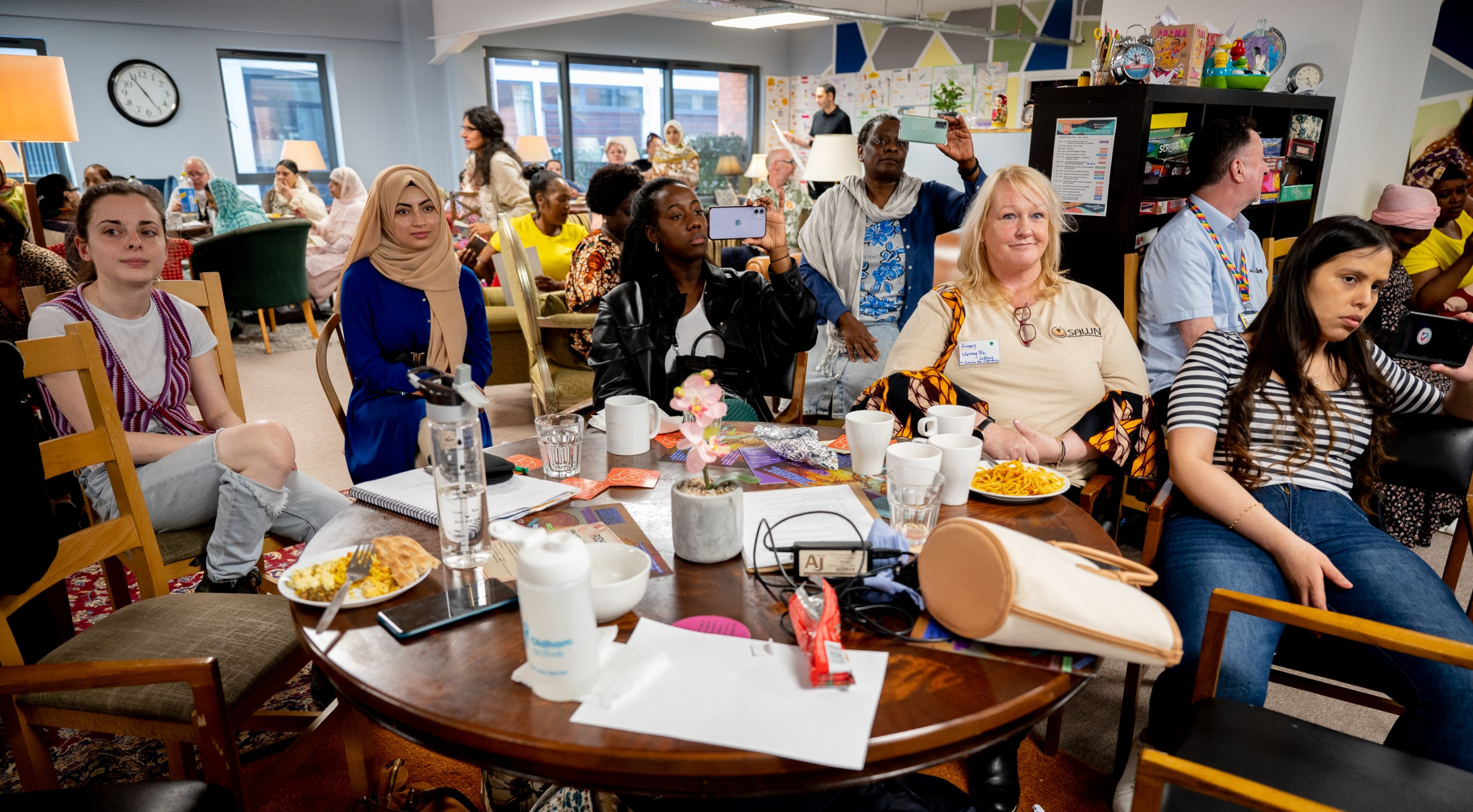
I’m currently collaborating with peers supported by the news and media fund to pool our insights and strengthen our practice. Thanks in part to an indirect grant from Lankelly Chase, we hosted a Festival of Learning – an eight day gathering to include in person and online, where civil society organisations came together to test ideas, compare notes and spark new partnerships. Watching people swap case studies over coffee and challenge one another reminded me that learning doesn’t just happen in reports; it happens in rooms full of curious minds. We keep returning to the same question – beyond the cheque, how can funders truly walk alongside us?
The answer, we think, lies in what we call ‘funder plus’. Rather than a one‑off transaction, it’s about embedding support, introducing grantees to networks, sharing technical expertise or even co‑designing initiatives. When a foundation values our organisation as more than a fundable line item; when they tap into our lived experience to lift up the programmes they’re underwriting – we all move faster. That’s the kind of reciprocal relationship I want every grantmaker to explore.
Crafting sustainable revenue for civic storytelling
In the next three years, I’d love to see Sounddelivery Media truly thriving, built on relationships, resilient to weather economic shifts and innovative to break free from dependence on philanthropy, trusts and foundations. Imagine a sector where we’re no longer scrambling for discretionary pots of money, but leading on new revenue models, testing purpose‑driven partnerships with public broadcasters and delivering content that communities trust and value.
We’re already taking steps in that direction by recruiting fresh leadership, rolling out larger-scale programmes and forging partnerships beyond the usual suspects. Yet at our core, we remain small enough to keep things personal, picking up the phone to a producer at 9am, sitting down over lunch to workshop a funding pitch, and celebrating every breakthrough, big or small. That balance of scale with soul, of ambition with intimacy is what will carry Sounddelivery Media from niche experiment to indispensable civic service.
Story Weaving by Tchiyiwe Chihana
Learn more about Generative Journalism Alliance