
Lankelly’s work funding movements arose from a conviction within the team that when existing social and political structures are unable or unwilling to come up with alternatives, social movements become the drivers of change.
Social movements come about when playing by the rules has proven to be ineffective again and again. Social movements aim to change the rules of the game, or even the game itself. They are not about access to the table of power, or representation around the table, but about constructing new rooms.
Considering Lankelly’s concern with systemic change and the root causes of social problems, we were late to the movements party. Colleagues who led this work had to carve out a space for it within the organisation and initially met with some resistance.
Once they had secured their mandate to move away from ‘building the field of systems change‘, the Resourcing Movements action inquiry began, exploring the role Lankelly could play to better support social movements.
We knew that traditional grant-making approaches could damage the way movements work e.g., through indiscriminate funding, funding that doesn’t consider the sustainability of the whole movement, or funding requirements that can lead to ‘movement capture’.
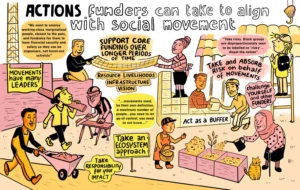
We also knew that direct funding is only one way to nurture movements – the wellbeing of movements is also important, as are spaces to build strategy and connections.
Part of this work involved us building our organisational capability and sensitivity by bringing in highly experienced people from the field, as we lacked the necessary knowledge and networks.
We were also pleased to work with a growing group of funders exploring accountable and movement-aligned philanthropic investment philosophies and practices.