
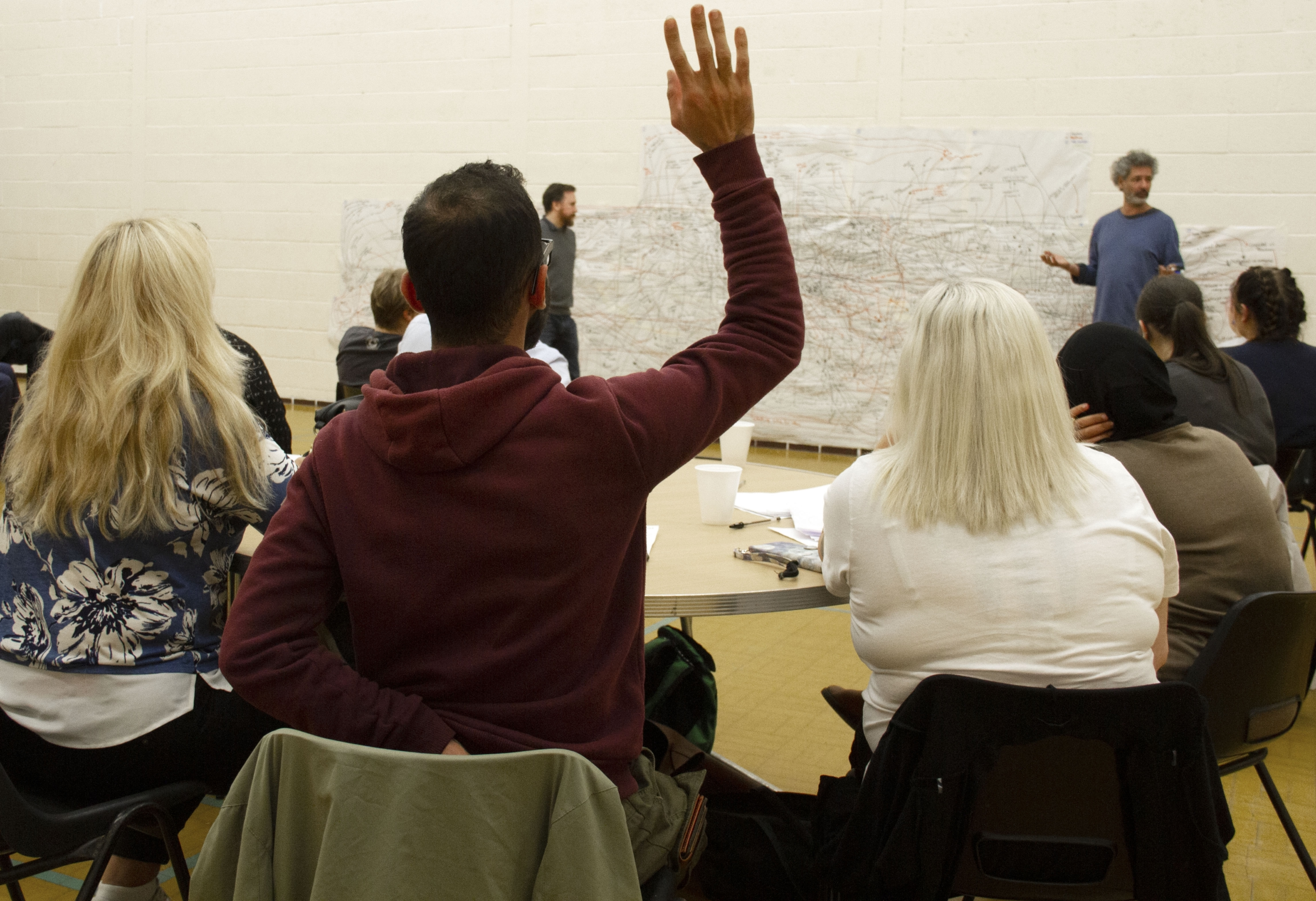
We used our rights and status as an investor to try to influence company behaviour.
The major case study of this approach was a shareholder resolution at Barclays AGM in 2020.
Together with partners, we wanted to get Barclays to phase out all of their fossil fuel financing.
This was the first resolution at a European bank on climate change.
Barclays had lent a lot of money to fossil fuel companies and provided underwriting services and various other financing mechanisms to support the expansion of their activities.
It was a positive example of drawing connections across our investments and grants work. We worked closely with ShareAction, a longstanding grantee, and Sarasin & Partners, one of our investment managers at the time.
Lankelly played a lead role in the process, joining meetings with the board of Barclays and its senior staff. We met the chairman of Barclays at their office in Canary Wharf. We were trying to negotiate with them.
Barclays aimed to be broadly sympathetic to our goal but argued the resolution would constrain them unhelpfully in achieving it by forcing them into a certain way of doing things. They suggested they would come up with an alternative plan to be voted on and asked us to withdraw our resolution.
We were working with a diverse group of investors, some of whom felt the bank was persuasive and acting in good faith. They wanted to withdraw the resolution.
Lankelly didn’t agree. We wanted Barclays to actively phase out financing the fossil fuel industry and suspected the bank’s alternative resolution would not deliver this. We wanted it to be first bank to set the example and shift the conditions in the market.
In our own thinking and analysis we used the ‘Three Horizons’ model of systems change and saw ourselves at ‘Horizon 3’: promoting “the long term successor to business-as-usual [which] grows from fringe activity in the present that introduces completely new ways of doing things, but which turn out to be much better fitted to the world that is emerging.”
So we ended up at odds with some of the other filers. This included being quite vocal in the press and we also carried out outreach with other investors and asset owners.
In the end Barclays put their own resolution up at the AGM, which was ostensibly similar but spoke of ambition rather than commitment, which we did not think was enough.
Our original resolution stayed on the ballot and was supported by 24% of shareholders.
This work sat alongside, and was intended to complement, our work to change what we were invested in.
Indeed, after our divestment from fossil fuel producers, we recognised the problem of investing in financial institutions which themselves are major sources of finance for fossil fuel expansion. It was one tool among others.
But it arose from the same realisation: that there was potential for our investment capital to be used in way that actually contributed to our mission and goals.
Our CEO Julian Corner talks about the impact foundations can have using these strategies.
Though our resolution was defeated, our philosophy and values as an organisation allowed us to push further than others could.
Ultimately, the work that ended up being embedded by Barclays was probably more stretching than it otherwise would have been.
Our resolution signalled that the bank’s own resolution was not good enough. It kept the pressure on Barclays, which has since been subject to further resolutions. Without this they could have come out of the process looking like a leader in the field.
Keeping our resolution on the agenda meant that campaigners can come back to Barclays and refer to it as a tool to hold them to account.
We learned about the limits of this kind of shareholder activism, particularly when it is directed at an individual company.
Ultimately many investors hadn’t wanted to push as far as we wanted to push in part because it could have been bad for the bank’s business model. It would have meant giving up certain clients and disadvantaging the bank in certain markets.
As investors in Barclays, some people felt this was a conflict – why invest in Barclays, only to hamstring them and take away their advantage?
We took a longer-term view and, anyway, Barclays was only a small part of our portfolio. Our view was ‘if this means Barclays is slightly less competitive as a business, that is fine’.
We also observed that other investors, particularly investment managers, had an incentive to ‘bank’ ostensible ‘wins’, even as simple as senior level access, so they could report progress to their clients. With no such pressures, we were frustrated by the readiness to make concessions around our core goals in order to be able to demonstrate proximity and apparent influence. Indeed, despite committing to keep the pressure on the bank to deliver on their alternative resolution, some investors who had advocated for it sold their Barclays shares soon after the AGM and moved their focus to other company engagements.
As we realised the limits of a shareholder action strategy focused on individual companies, we started getting interested in the concept of systems stewardship.
This is about engaging the wider system, at a sectoral, policy and/or regulatory level, in a way which lifts the bar for all companies. It involves looking for leverage points to shift some of the conditions, rules or mental models which underpin the whole system.
This means you are not expecting one company to be the first mover and to disadvantage itself. It also recognises that engaging and changing one company does not necessarily affect the market because other companies will move into any vacated space.
(It was also the case that as we shifted our capital allocation, our portfolio companies were less likely to be so egregiously in need of shareholder engagement).
We funded some grantees to pursue these kinds of strategies, including a strategic litigation aroudn the fiduciary duties of directors, coordinated by Shareholder Commons.
We understood that collaboration, including with other foundations, is key.
Catherine Howarth of and Jeanne Martin of ShareAction were key collaborators.
Shareholder Commons was also an important partner.
Resources
-

Transparency can Transform the Impact of our Investments
Dominic Burke
2021
- Investments
-

Investing Beyond the Growth Paradigm
Dominic Burke
2021
- Investments
-

How Should Charities Invest?
Dominic Burke
2021
- Investments
-

Fixing Responsible Investment’s Democratic Deficit
Dominic Burke
2023
- Governance,
- Investments
-

Charitable Endowments: The £68bn Elephants in the Room?
Dominic Burke
2020
- Investments
-

Barriers to Responsible Investment – collaborative letter
Dominic Burke
2021
- Investments
Other related stories
-
Address fundamental issues like power and wealth
A golden thread to make the scale of change we aspire to.
Chris Dabbs, Unlimited Potential Read more -
Backing the country’s first community-led investment fund
I’d love to see philanthropy let go of the old ways and stop sitting on massive funds.
Cameron Bray, Barking & Dagenham… Read more -
The dual role of grant giving organisations
Trying to square the circle of ethical and responsible investing.
Catherine Haworth, ShareAction Read more