

When Lankelly’s grantees came together between 2012 and 2014, much of the conversation was about the difficulty of enacting the change they were seeking because of things outside their control locally.
They talked about unhelpful commissioning arrangements, siloed services and a culture of competition between third sector organisations.
The groups we funded did not have the ability to change these things on their own – no single organisation did, even one as seemingly large and powerful as the local authority.
This was where one of our key organisational learning points came from – that outcomes emerge from the actions of whole systems.
We were influenced by the approach of Malik Gul at Wandsworth Community Empowerment Network, who had spent many years bringing people together across local systems to nurture better relationships and a shared agenda for change.
At the same time, Lankelly was developing its awareness of systems thinking and systems change methodologies. Something that came up in discussion was the need for a boundary for our activity. ‘Place’ made sense.
At this point, Lankelly’s thinking was mainly concerned with services – how to ensure people facing severe and multiple disadvantage got the support they needed. This meant public services, and therefore local authorities and other large statutory institutions, were highly relevant to our agenda.
Malik was again a critical voice, pushing Lankelly to have a coherent ‘theory of money’ in relation to public institutions with annual budgets in the hundreds of millions. (He expands on some of these thoughts in our stories section).
Foundations can’t match or replace public services – so what is it that philanthropic resources can enable?
By this point (2015) we were convinced that ‘place’ needed to be part of our strategy. We convened large-scale conversations of more than 200 people to help us shape this.
What came out of these conversations was a decision that it did not make sense for Lankelly to fund services at scale, but that we could resource relationship building. We thought of trusting and aligned relationships as the roots of change; we thought that other funders could pick up the more tangible things.
Having made this decision, the next question was: where do we start? Should we have an open programme and invite people to apply? Should we start with our existing grantees and relationships? Should we use the Indices of Multiple Deprivation to select places? All of these had pros and cons.
In the end, we decided to follow the threads of the relationships we were already in.
This led us to Barrow-in-Furness, where social workers at Love Barrow Families were trying to bring people together across different organisations to improve outcomes for children and families.
In York, there was already a network of concerned people who had come together around a project focused on the needs and experiences of people who repeatedly call the emergency services because of mental distress.
Barking and Dagenham, Oxford and Gateshead were also relationship-driven. Our focus on Manchester came about as a result of the ‘Elephants‘ project – a space for dialogue between people with lived experience of severe and multiple disadvantage and ‘system leaders’.
By 2017, we were working with networks of people in all these places, primarily through ‘associates’. These were people acting as intermediaries between us and networks of local people. They sometimes likened their role to relationship ‘weaving’.
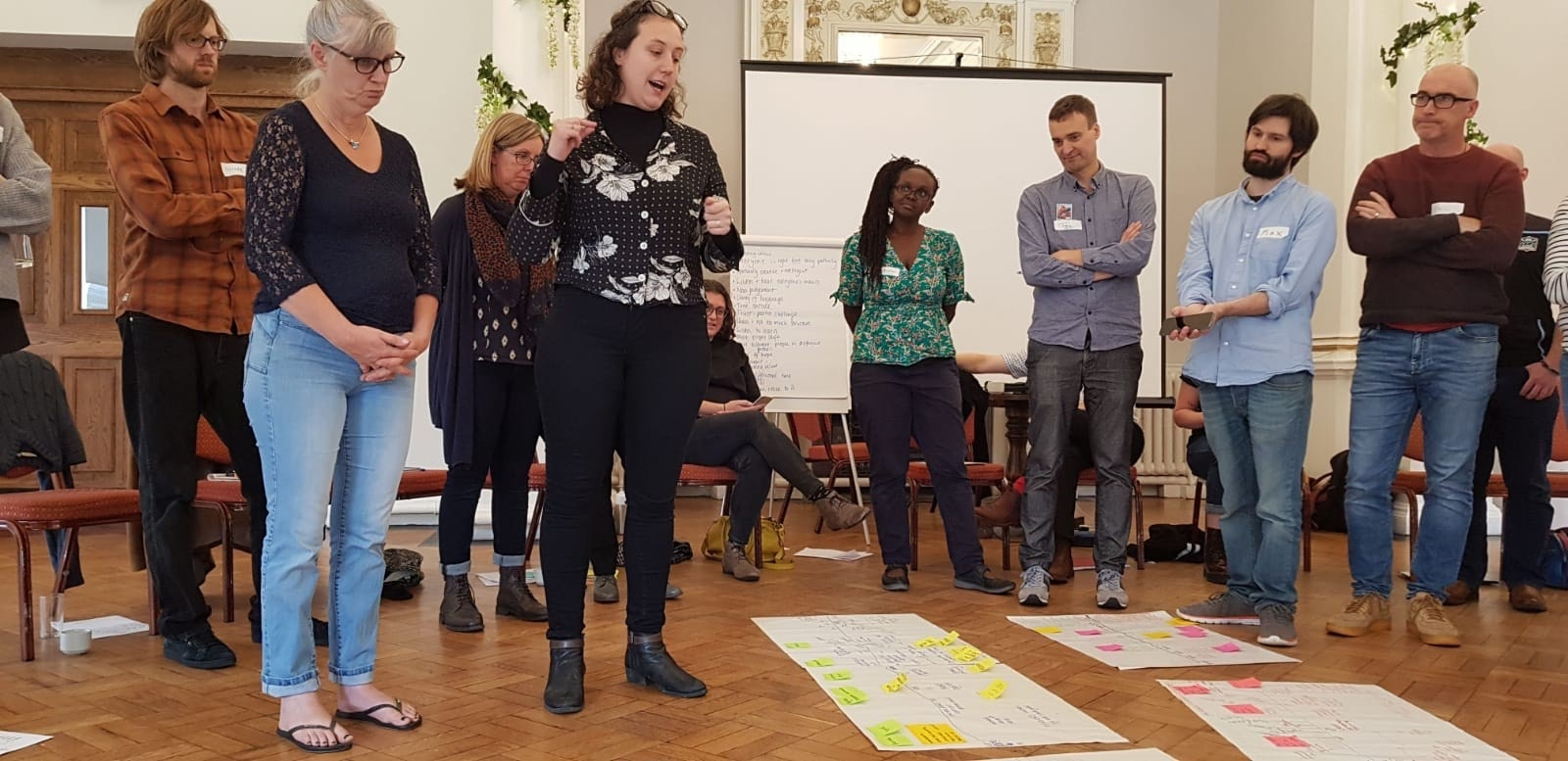
The initiatives we worked with went on to become developed, assertive and energetic networks of local people with a shared commitment to change.
As a relatively neutral party, we could go into meetings with senior people in local authorities and hold space for open conversations – including about their own sense of stuckness. Many people, even very high up in large institutions, felt trapped and powerless and unable to make the change they knew was needed. At our best, we could open up spaces of possibility and creativity – the sense that things could be different.
Lankelly’s work (in particular our partnership with our learning partner Toby Lowe) was part of a wider critique of top-down, target-led ‘New Public Management’ in public services.
We still hear from people in statutory institutions who found some of our work useful, especially the System Behaviours, which provided an alternative framework for thinking about role, performance and outcomes.
Some people found Lankelly’s learning-led, iterative approach to starting this work refreshing. Others just found it confusing.
We were often asked ‘what is it that you want?’ and advised to create more parameters or to codify our approach. This felt wrong to us as a funder trying to devolve power.
Confusion sometimes extended to the Lankelly team, especially people coming into the place work who hadn’t been involved from the beginning. It wasn’t always easy to explain the rationale for decisions when things had evolved in a highly relational way. Some of the core tenets (e.g. not funding services) were challenged (legitimately). Some people felt we should have worked in other places with greater levels of need.
Lankelly’s own strategy changed at a different pace (and sometimes in a different direction) to the local place-based work. This led to some excruciating moments when Lankelly staff expounded on the most recent developments in our organisational thinking and tried to encourage the people we were working with to ‘come along’.
We wondered if getting into these tangles (and plenty of others) was inevitable for a national funder trying to be an active protagonist in work in local communities.
We certainly made avoidable mistakes, but we’d suggest any funder stepping into similar work should have an awareness of these issues and thoughtfully develop a practice around them.
As part of setting up the work in 2015, colleagues negotiated a £1m funding ‘envelope’ from the Board. This was the first time the board delegated spend.
They agreed that staff members needed to be able to act quickly and flexibly to resource things as they were establishing the work, without having to come back to the board for every funding decision. This quickly led to delegated authority in other areas of the foundation’s work.
The large-scale convenings and consultations which preceded the place-based work resulted in a kind of ‘manifesto’ describing the characteristics of healthy systems that would function well for everyone. These became the ‘System Behaviours’ which guided the work of the foundation for several years.
Skilled associates holding complex processes in local places included Paul Connery in Manchester, Catherine Scott and Kelly Cunningham in York, Andy Crosbie in Gateshead, Sarah Fernandez in Oxford and Avril McIntyre in Barking and Dagenham.
Resources
-
Historical Review of Place
IVAR
2017
- Place-based work
-
Place Action Inquiry – Learning Report
Max French, Toby Lowe
2018
- Place-based work,
- Systems change
-
An Introduction to our Place-Based Work
Habiba Nabatu
2018
- Place-based work
-

Place-based Systems Change – board paper
Alice Evans
2016
- Place-based work,
- Systems change
-

Lankelly’s Journey into Place
Julian Corner
2022
- Place-based work
Related stories
-
Shifting how people relate to each other
Learning from community-led Systemic Action Research in Gateshead
Jo Howard, Institute of Development Studies Read more -
Lankelly arrived with open hands, not a blueprint
How open-handed partnership transformed Barking and Dagenham.
Monica Needs Read more -
Become a systems change funder
How to fund the change when you’re part of the problem.
Alice Evans Read more