
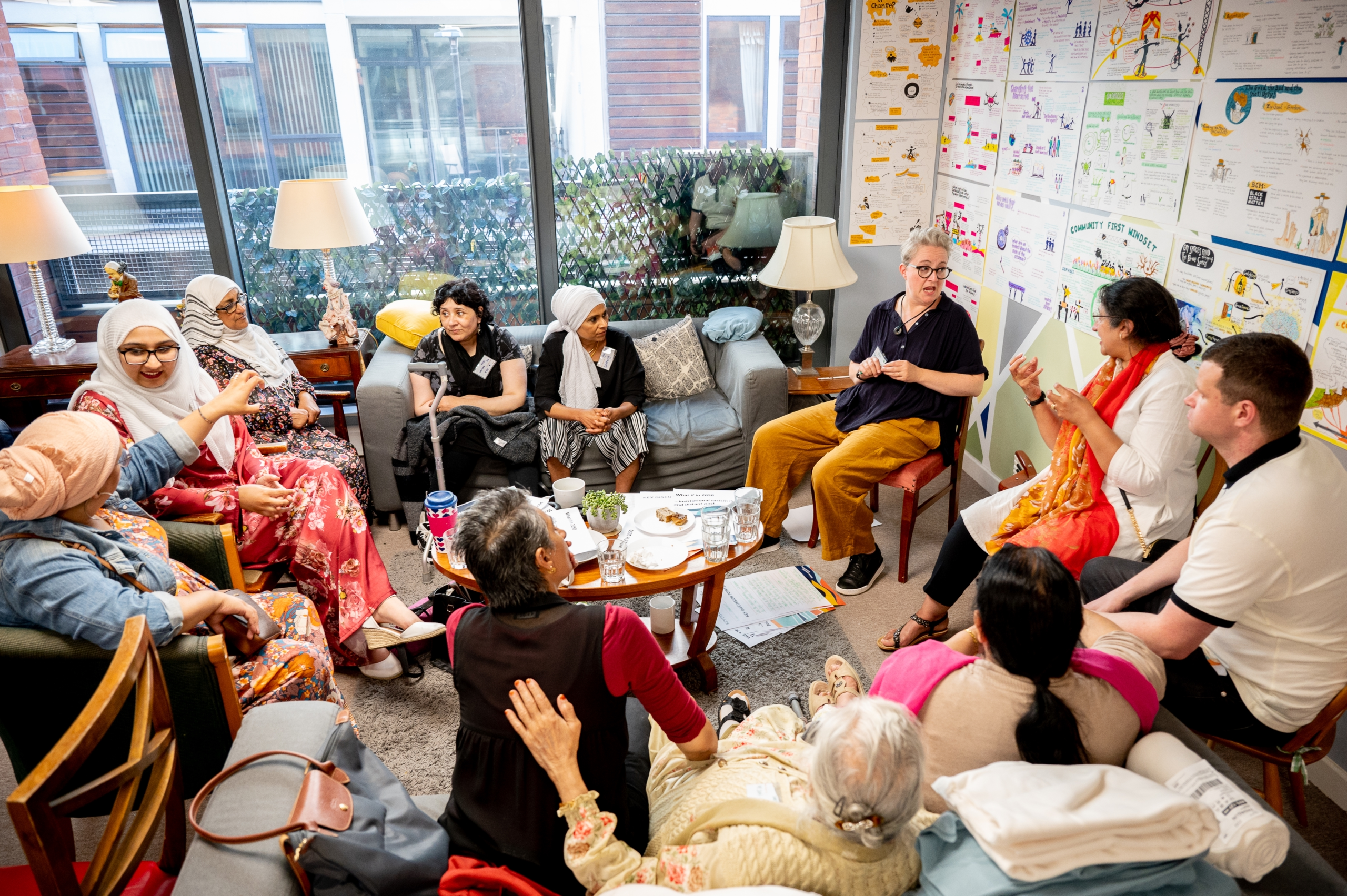
We were working in Barking & Dagenham, Gateshead, Greater Manchester, Oxford and York. By this point there were large numbers of people connected via strong and weak ties to the work – often involved in participatory processes of decision making and resource allocation. Because the work had started during the phase of Lankelly’s life when we were focused on interlocking social harms, most of it was framed in this way too, based around the question ‘how do you change the systems that perpetuate severe and multiple disadvantage?‘
There was a flowering of activity of different kinds. Structures, approaches and activities varied a great deal, but there were some constants. In each place there was a mixed ‘core group’ of local people stewarding the work and resources, and an ‘associate’ role, tasked with weaving or knitting the different elements together, providing coordinating capacity and ‘backbone’. Each core group considered itself to be temporary, aware of the dangers of power ‘settling’.
Over this period we delegated decision making over Lankelly’s resources and strategy to the core groups in each place.
We were also a funder-partner in LocalMotion and supported the Corra Foundation’s place-based work in Scotland.
Lankelly team members were involved as peers and protagonists in the local work, as well as trying to ensure there was cross-place learning.
We made sure flexible resourcing was available
We – and our partners – knew ‘Lankelly money’ could work differently from that of most other foundations and could be used very flexibly. It freed people up to take part in and try new things, and it demonstrated that different resource flows are possible (though we could not replace other resources at scale). We also managed the actual administrative process of getting money out on behalf of local decision makers, holding some of the financial risk, and making sure financial processes were legal and appropriate.
We provided support, mentoring and coaching for key people involved
We had good, close relationships with many of the people involved (associates and others) and we provided support when needed (which seemed to be often/a lot). This varied between mentoring (sharing our experience), coaching (holding a space for people to work things out for themselves) and pastoral support (being there when it was hard, listening and encouraging).
We connected people, initiatives and ideas across the work
This included retreats, seminars and other events.
We brought in ideas and methodologies from elsewhere
We were connected to lots of different thinking and practice in relevant fields, and could bring this in and make suggestions for things that we thought could be useful. This was a balancing act – as the funder, it was very easy for this to be interpreted as direction without us meaning it to, and we definitely got it wrong at points.
We held a focus on system-level action and extreme marginalisation
We kept the space open for work that wasn’t about the growth of any one organisation or a response to any particular symptomatic issue.
We cleared the path as and when we are asked to
At times we used our rank, profile and reputation to help maintain the space for our partners to do their stuff locally.
In all the work there were elements of luck, coincidence and timing. If the work in Greater Manchester had started a year earlier, for example, it would have been rooted in Lankelly’s concerns about ‘severe and multiple disadvantage’ rather than collective liberation, and would have been different as a result.
This speaks of the importance of starting points – the logical implications of which can be difficult to escape from as they unfold over time.
Funders have huge power in setting parameters and imprinting their thinking and concerns on any process. In addition (and obviously), the worldviews, experience and perspectives of the people involved from the beginning shape the work.
We knew that working in a place-based way was a long-term commitment. By 2022, it had been 7 years, and by the time we exited, 10 years – and the work goes on without us. However, we still did our budgeting annually, and even when we devolved decision making to local groups, these core teams had to come back to Lankelly each year with a proposal for an annual budget (although some parts of the work were funded by longer term-grants, and generous budgets with flexible underspends smoothed over some of the cliff-edge dynamics). If we were doing this again, we’d make sure budgeting rounds were longer, to give all involved more security and freedom.
Our best work was pretty good – for example, the deep and rigorous 3-month process we held to establish the core group in one of the places. This involved the group exploring our worldviews as individuals, establishing processes and deciding what practices to use, and generally working out how to be together as a team encompassing people from the place and people from the funder. We struggled to systematise this kind of good practice across the places, with much depending on the personalities, interests and preferences of the Lankelly leads in each place (in a team used to individual freedom). Every time we did it, we were using new and different processes.
There was a lack of an agreed organisational practice, which at times left people floundering in a space where dynamics around power, privilege and positionality were all extremely complex.
A consistent theme across this retrospective is that Lankelly needed clearer boundaries, parameters and shared practices, as well as agreed processes and timelines for reviewing these as part of the action inquiry cycle. Without these things, anchors were missing – particularly as Lankelly’s horizons got bigger – and people felt disorientated and adrift as a result.
There is a funder ‘loop’ here that we’ve referred to elsewhere: We wanted to devolve power and felt uncomfortable imposing our own thoughts and boundaries onto a group of actors in a place. We asked them to come up with their own definitions, frameworks and ideas. Totally unsurprisingly, we didn’t always wholly approve of what they came up with (which we felt guilty about). We were then tempted to impose our own thinking, but couldn’t because we wanted to devolve power…. and it went on and on. This was felt in an emotional sense by the people we were working with.
Perhaps it is possible to be an endowed foundation and break out of this loop and work in a healthy, power-aware and transparent way. But we did not manage it.
Devolving decision making in the place work – explored in depth in this report – was freeing, and it enabled the resourcing of people and organisations Lankelly would never otherwise have been able to connect with. However, there were issues that could have been managed better – particularly the care of local decision makers who we could have provided with more security. We devolved power, but we also devolved the risk which accompanies it, and we should have attended to this more closely.
We struggled to find a way of gathering the learning, both in terms of breadth and depth. We again got stuck in the loop of whether to impose a process across the work, or for people to determine their own processes (but then how would we know what was happening?) It seemed impossible to be involved and to learn, without centring ourselves and being extractive.
These dynamics, and others inside Lankelly, were extremely and inherently complex. We’ve already seen that place-based work takes many years of commitment. The likelihood of any institution, let alone a funder, being able to consistently hold this work well over a long period of time must be quite low. Institutions have their own issues internally, and their own problems, imperatives and concerns.
We wonder whether institutions (particularly hierarchical ones) lend themselves to this work, or whether the old adage ‘never doubt that a small group of thoughtful, committed citizens can change the world’ suggests some other configuration of people and resources.
Exiting from the place-based work was one of the hardest and most contested parts of preparing for the ‘transition pathway’ process.
We know some people we had worked with felt ‘pushed away’ (in the words of Andy Crosbie in Gateshead).
In the place work, and in other work, we had spent years supporting clusters of people to whom resources could be delegated. One potential trajectory could have been that each place developed into a self-regulating community of practice.
Though we may be wrong, our assessment was that it was impossible to de-centre Lankelly in such processes. The funder would still have been holding the overall strategy and feeding in resources. The work would still have been happening in the shadow of what Lankelly wanted and believed was necessary. The ghost of Lankelly Chase would have still been there in the room.
Resources
-
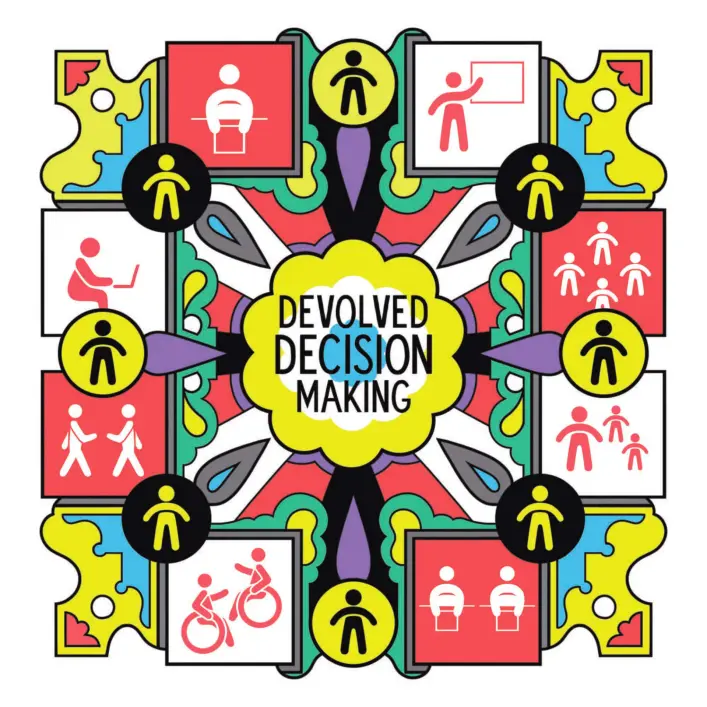
Devolved Decision Making: Sharing Power and Resources in Place-based Change Work
Max French et al
2024
- Devolving decision making,
- Philanthropy,
- Place-based work
-
Learning Partner – Invitation to Tender
Cathy Stancer
2021
- Action inquiry,
- Learning,
- Place-based work
-
An Introduction to our Place-Based Work
Habiba Nabatu
2018
- Place-based work
-

Common Ground: a series of reports on our place-based work
Various authors
2022
- Learning,
- Place-based work,
- Systems change
-

A History of Our Work in Greater Manchester
Carrina Gaffney
2024
- Devolving decision making,
- Grant-making practice,
- Place-based work
Related stories
-
Devolved decision making revolutionary in Manchester
What is it like for a local team to hold money and make decisions on their own behalf?
Paul Connery, GM Systems Changers Read more -
Shifting how people relate to each other
Learning from community-led Systemic Action Research in Gateshead
Jo Howard, Institute of Development Studies Read more -
Going in circles
The intention was to be very different, but the reality was messy.
Catherine Scott Read more