

Lankelly had always funded charities delivering services to people facing different problems.
When we changed our mission to focus on severe and multiple disadvantage, this continued. We looked for different charities to support, but we still mainly focused on how charities could meet need.
The Lankelly staff team were largely made up of people who had worked in charities, in service delivery, policy and campaigning roles. We knew and understood the field.
Our first foray into funding under our new mission was a group of organisations we brought together as the ‘Promoting Change Network’. This was largely made up of service delivery charities, but these were disruptive and innovative organisations. They were values-driven and most worked in a highly relational way, pushing at the boundaries of practice. They were also ambitious to promote systemic change.
When we convened these organisations, they talked about their experience of bumping up against statutory services and commissioners, about trying to meet ‘failure demand’ and about the inverse care law – i.e. that people who need support the most are least likely to receive it.
Together with these organisations, we identified challenges within the statutory systems charged with supporting people facing severe and multiple disadvantage. These challenges seemed an important area of focus in our work to change systems.
This work started around 2014, and at that time, there were already well-rehearsed critiques of the often siloed, risk-averse and overly rigid nature of statutory services.
Added into this were austerity and deep cuts, which one council we visited said had triggered the thresholds for their emergency response team. The ‘graph of doom‘, which showed funding for adult social care and children’s services eclipsing local authority income, had already made the news.
The impact on people was (and is) devastating, with individuals falling between the gaps in services altogether, being viewed through a succession of separate and uncoordinated ‘professional lenses’ and/or experiencing stigmatising, coercive and outright harmful interventions.

Julian Corner, our CEO, talks about the context of our work on public services
We recognised that it was not helpful to castigate statutory system leaders, who were often frustrated and depressed by the system failings we observed.
At the time, we said “there were good reasons behind the introduction of all these [systems], but over time they have evolved to create their own issues, many of which weren’t intended. Rather than each time going back to first principles, attempts to rectify unintended consequences have in many instances layered more complexity and structures onto the system”.
Plenty of research and commentary setting out the problems existed, and there didn’t seem to be resistance to the idea that change was needed. What we did hear was that people – including very senior people – felt stuck and didn’t know how to begin. The complexity of statutory systems and the scale of the change needed were overwhelming.
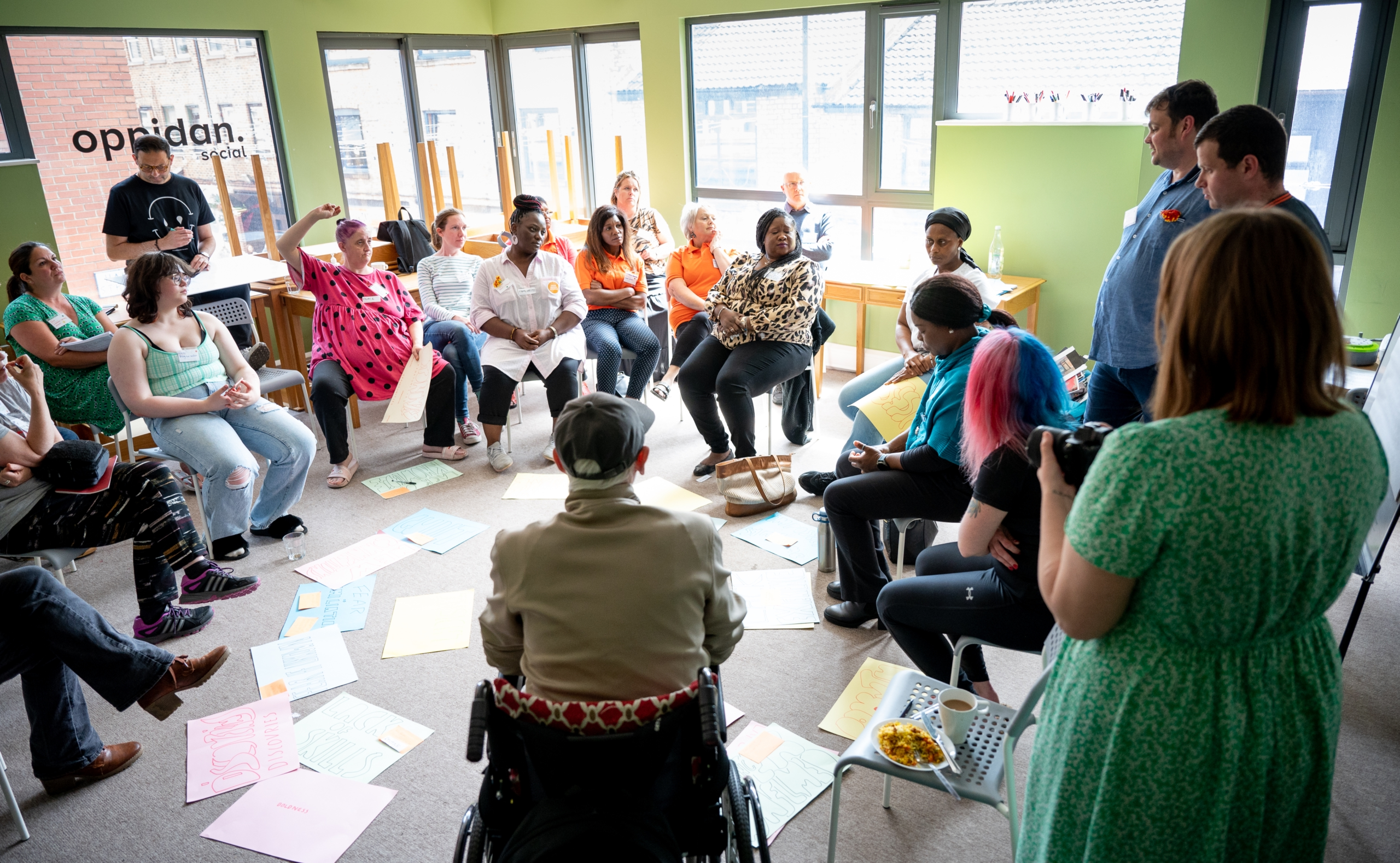
We took an approach rooted in dialogue, aiming to “help create protected spaces where people can be curious, take risks, show vulnerability and experiment with new ideas. It is hard to create these spaces, as people are often stuck in roles. We have found that the more techniques allow people to step outside of their role – of funder, grantee, trustee, service user, commissioner, frontline worker – [the more they can] explore safely“.
In some of our place-based work, local authority leaders were the ones who invited us in and we took a very active role as a protagonist, convening and facilitating conversations about change.
Elsewhere, we funded work by organisations like Collaborate to support local authorities in their reform work. We supported Human Learning Systems with their comprehensive and powerful critique of ‘new public management‘ and their advocacy of learning-led, complexity-appropriate approaches to the design and management of public services. We funded Participatory City and a process of co-production between ‘system leaders’ and people with lived experience in Manchester called the Elephants project (named for the elephant in the room).
Clearly the crisis in public services was not addressed by our work. However, we were part of a wider move towards reform based on an appreciation of complexity, the value of systems thinking, and the importance of lived experience and relational working.
Public sector leaders told us they appreciated the space and time we provided as well as the encouragement to think differently. Some people felt their positions supported, vindicated and legitimised by us.
Arguably, the dysfunctional power dynamics that are part and parcel of philanthropy were less visible in this work, as public sector staff didn’t necessarily have the same expectations of us (in terms of grant funding) that charity leaders did. They didn’t really know what to make of us and as such, we could operate without some of the ‘baggage’ of being a funder.
Later in our organisational journey we were exposed to an alternative narrative to the one above: that systems are actually working as intended, and that the subjugation and oppression of marginalised people is not a flaw but a feature.
This is not to say that public sector leaders are consciously enacting oppression, but that the historical provenance of many of our public systems is rooted in control rather than a desire for human flourishing.
It is undeniable that the most coercive statutory interventions – from having your children removed, to being sanctioned by the benefits system, to being sent to prison – are disproportionately visited on the most marginalised in terms of poverty, class, disability and race. This leads us to question whether the relatively gentle reform-focused processes we led and funded were an adequate response.
Nevertheless, the question about how to change things is still relevant.
Resources
-

Behaving Like a System?
Collaborate CIC
2015
- Place-based work,
- Public services,
- Systems change
-

Systems Change: What it is and how to do it
2018
- Complexity,
- Systems change
-

Thinking Big: How to use Theory of Change for Systems Change
NPC
2018
- Complexity,
- Systems change
-

Lankelly Chase’s Approach to Working with Complexity
Julian Corner
2018
- ‘System Behaviours’,
- Complexity,
- Systems change
Related stories
-
Enhancing lives beyond traditional metrics
How Rob McCabe and Lankelly Chase pioneered relational support in Birmingham.
Birmingham Pathfinder Read more -
We need radically different futures
We cannot rely on our public institutions.
Malik Gul, Wandsworth Community Empowerment Network Read more -
Become a systems change funder
How to fund the change when you’re part of the problem.
Alice Evans Read more