
Observations of the organisations we funded and consultation with hundreds of people helped us identify some core behaviours that seemed to account for positive, healthy change in any organisation, community or system.
We distilled these to a list of 9 ‘System Behaviours’ which guided our work for several years. Anyone who came to the Lankelly office would have seen them in a prominent place on the wall.
Our CEO, Julian Corner explains how we arrived at them, what they meant, and the impact they have had
Perspective
We are part of an interconnected whole
We are all connected in a web of life. Our individual actions are part of a hive of activity that is made up of the contributions of many people.
People share a vision
People gather around a shared vision and appreciate each other’s views. We all want the whole system to work, even if we know we can’t control it.
People are resourceful with many strengths
We make up an intelligent network of people who have both strengths and weaknesses, and continually learn and grow with each other.
Participation
Open, trusting relationships enable effective dialogue
People feel safe to ask the difficult questions, voice agreements and disagreements, and deal with the conflicts and uncomfortable emotions that may surface.
Leadership is collaborative and promoted at every level
There are different styles of leadership which call on a variety of skills and strengths. Everyone has the potential to be a leader, wherever we are in a system.
Feedback and collective learning inform adaptation
The understanding of a ‘problem’, actions taken to ‘change it’ and what we learn from this interaction continuously inform each other. A culture of experimentation exists, where we embrace failure for what it will teach us.
Power
Power is shared, and equality of voice actively promoted
We can all play our fullest role in creating an effective system. Unequal distribution of power, including structural inequality, is continually challenged.
Decision-making is devolved
People closest to a complex situation are free to use their initiative to engage and take responsibility for their own change.
Accountability is mutual
People are encouraged to be accountable to each other and our actions without fear of failure and judgement. System improvements are driven by accountability to the people being ‘served’.
Our Chair at the time, Myron Rogers, had a maxim that we often repeated – the process you use to get to the future is the future you get.
The system behaviours were both a guide for our own actions and behaviour (at the individual and organisational level) and represented the change we wanted to see out in the world. They were the process and the outcome.
Among other things, they were part of staff appraisals at Lankelly; featured in the ‘working together’ document that sometimes accompanied funding agreements; used as prompts for reflective practice; and helped to structure co-design workshops. For a time, the learning partners in our place-based work tried to track whether local systems were changing to embody more of them. This case study goes into more detail about their use.
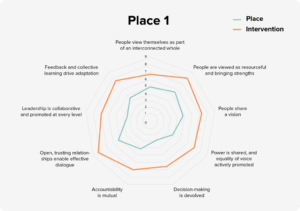
They were influential outside the organisation too, particularly in the public sector, where they were employed as part of change processes. We were told they were useful to public sector commissioners who had come to the realisation that their role was not to commission services to deliver outcomes, but to help shape the system conditions from which good outcomes emerge.
The system behaviours were always intended to be a ‘good enough’ foundation to support our work.
They were not set in stone, and review and iteration was part of the plan.
In true Lankelly style, we did not rigorously execute this intention. New people joined the organisation and were agnostic about the system behaviours, not having been part of the process which led to their development (another ‘Myron maxim’ which was true in our experience was ‘people own what they help to create’). This meant that some staff used them in their work, but others didn’t, so they were more prominent and some areas of our work than others.
There was also a sense of fatigue and dissonance with them as the organisation struggled to live up to them internally – some of those dynamics are discussed here.
They faded from our work, rather than being reviewed and developed or definitively abandoned.

Resources


Related stories
-
Becoming learning partners
Lankelly showed that funding for learning was a possibility, but held their truths too lightly.
Toby Lowe, Manchester… Read more -
Become a systems change funder
How to fund the change when you’re part of the problem.
Alice Evans Read more -
Devolved decision making revolutionary in Manchester
What is it like for a local team to hold money and make decisions on their own behalf?
Paul Connery, GM Systems Changers Read more