

Reflections
Mary Wollestonecraft
There were some important ‘a-ha’ moments in our organisational journey which expanded our awareness and changed the way we saw things. Of course we are not the only ones to have had these realisations; we are the beneficiaries of the wisdom of many who have come before us. These moments foreshadowed or made possible the transition pathway decision.
We felt a huge responsibility to make the most of this position and to keep in mind the question “if we can’t then who can?”
We described ‘SMD’ as “the persistent clustering of severe social harms, particularly homelessness, substance misuse, mental and physical illness, extreme poverty, and violence and abuse”.
The commitment to work on this issue meant we were immediately in a space where simple or linear solutions were obviously inadequate.
However, exposure to complexity theory and systems thinking meant we became aware of whole fields of relevant thought and practice, and communities of people worldwide grappling with similar issues to us.
Once you start to see yourself as part of – rather than apart from – a system, then a lack of congruence between how you act and the change you want to see shows up pretty quickly.
The clearest example of this was in relation to Lankelly’s investments.
This position was a critique of the dominant charitable model, in which individual organisations are encouraged and incentivised to credit themselves with outcomes that can only be created by factors well beyond their control.
It meant we needed to focus on the underlying dynamics or conditions in a system, like the way power works, rather than any particular issue, intervention or organisation.
The ‘System Behaviours’ were a co-produced list of the conditions present in a healthy system that guided our work for several years.
This was hardly a new argument (as the Mary Wollstonecraft quote above illustrates), but it was a development for us to build it into our thinking and it most certainly helped pave the way for the transition pathway decision.
This illustrated speech by Slavoj Žižek from 2009 sums it up nicely:
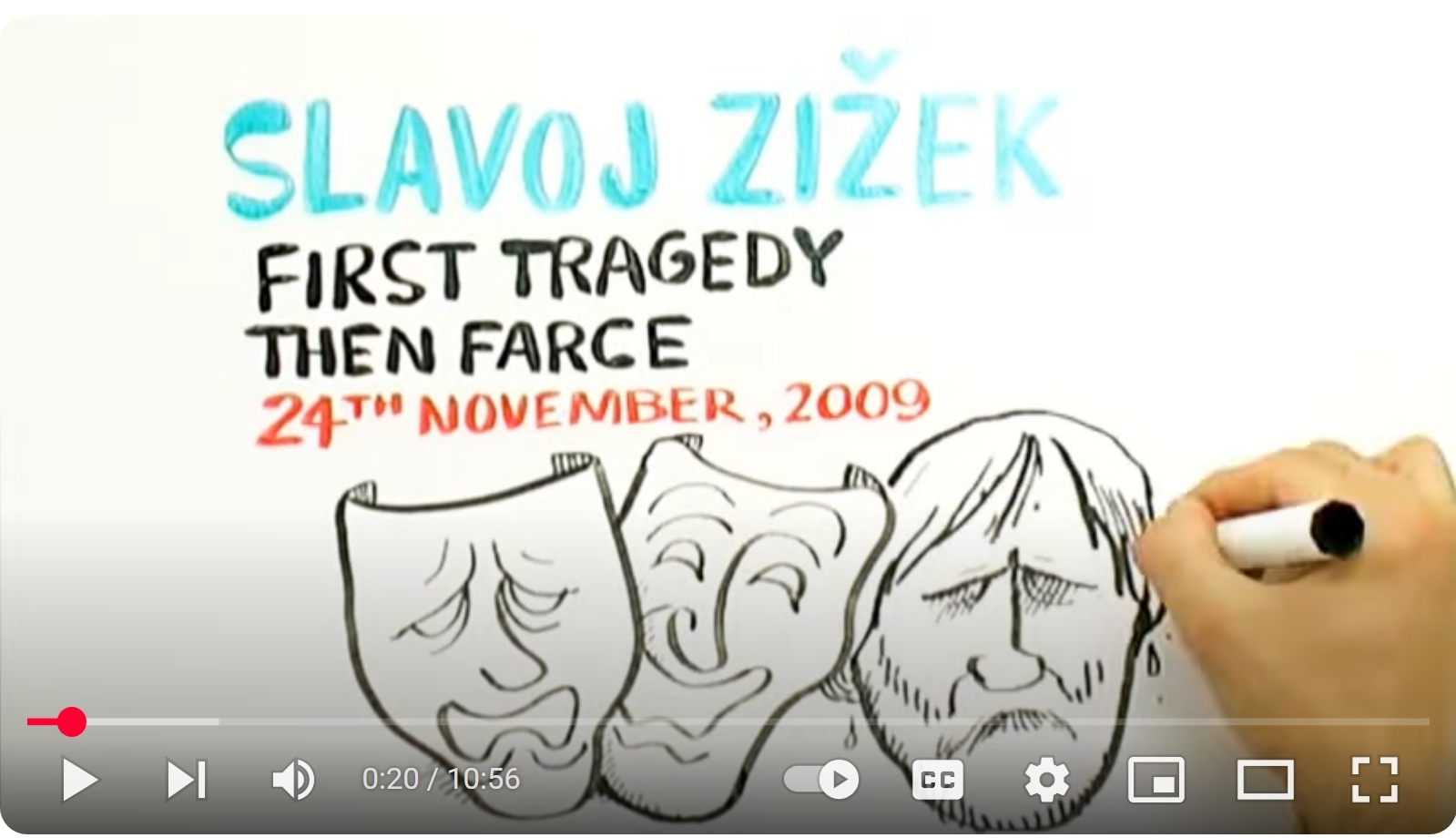
“We [funders] need a massive reimagining of our purpose. Our purpose is too often to be ‘still around’, dribbling out bits of money. Part of what’s needed is for funders to stop seeing the little pot of gold they are sitting on as their money and start thinking about it as the system’s money in the wrong place”.
Though we talk about ‘our resources’ on this site, in general the team avoided this language. We wanted to rid ourselves of any sense of ownership or control, and to think more about the processes by which money could flow freely to where it was needed.
In coming to the transition pathway decision, the trustees asked themselves:
What does it mean to say ‘it’s not our money’? How deeply should the answer to that question shape our future?
All of this led us to the awareness of the need for a fundamental shift in thinking and perspective – the ‘ontological shift’ – to “identify, untangle and actively unlearn the deep logics we have internalised.”
These were all ‘freeing’ realisations that enabled us to follow the bouncing ball of inquiry in new directions.
There were other things, which were just as influential, which held us back and got in the way, and created harm and anxiety. We weren’t always aware of these at the time.
It is hard to untangle the issues that could be resolved with better practice from the issues inherent in philanthropy.
Was it actually possible for a philanthropic institution like Lankelly to hold the complexity of systems change work effectively and with legitimacy?
This is debatable. However, there are some clues in the stories from our grantees and other collaborators…