Timeline
Our story
After many years operating as a grant funder for charities working on social justice issues, in 2011, Lankelly Chase adopted a systems change approach, focusing on ‘severe and multiple disadvantage’.
But as a funder, we held disproportionate power in shaping that focus—and we came to see it had excluded many, especially people and communities of colour. We learned from this, and worked for many years to try to mitigate philanthropic power imbalances. Our conclusion was that these power imbalances are baked into the model.
Yet through this work, we encountered powerful community-rooted practices grounded in mutuality, care, and interdependence. Despite their effectiveness, these approaches remained largely sidelined by mainstream philanthropy. The growing polycrisis of interlinked environmental, social, and political breakdowns magnified our feelings of dissonance and unease as it became clear to us that piecemeal reforms within institutional philanthropy were not enough.
In 2022, we chose a different path and committed to redistributing all our resources. By stepping back, we aimed to create a space for the emergence of new, life-affirming ways of resourcing social justice work.
2025
New beginnings
Whilst hospicing the old Lankelly Chase, trustees, colleagues and collaborators start to imagine the new.
Endings
Lankelly winds down its operations as a funder. We step out of the work and the team starts to disband ahead of a radical restructure.
2024
Going public
The transition pathway decision is announced publicly and we hold a number of open consultation events.
Setting our affairs in order
This includes making grants to organisations facing immediate financial precarity as a result of our decision.
Alongside partners in our place-based work, we establish an independent fund they will steward.
2023
The decision to close
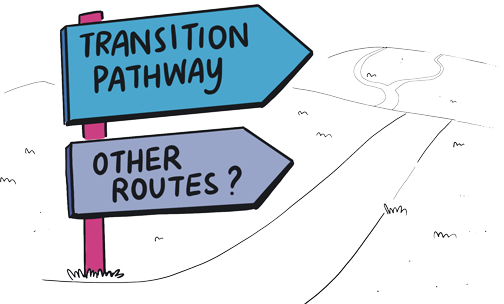
In June, after a series of discussions at prior meetings, the trustees decide the foundation will redistribute all its assets, and close within five years. This becomes known as the ‘Transition Pathway’.
The intention is “to model and co-create the [alternative] resourcing infrastructures that social justice work desperately needs”.
The rationale
Central to the argument is the idea of irreconcilable contradiction.
We noted that: “Since Carnegie and Rockefeller’s time, institutional philanthropy has made big claims to solving entrenched social problems, but it has done nothing to resist or transform the dominant system that created them”.
“We have concluded that the contradictions and flaws of institutional philanthropy can’t be resolved through improvements and reform…We don’t need better strategies, we need to take different paths”.
The reaction
Some people experience the decision as a disjuncture and/or a disappointment.
Others see it as the necessary next step in Lankelly’s work, already foreshadowed by critical friends and grantees.
2022
Movements
By now, the work which began as ‘building the field of systems change’ has been developed into ‘movements’.
We are funding internationalist, intersectional, solidarity-based anti-oppression networks.
These new grantees expose us to more developed analyses of power and inequity.
The endowment #3
Despite our efforts to align our endowment with our mission, Lankelly’s continued investment in global markets means the sustainability of our work remains dependent on economic growth, despite evidence that growth is fuelling escalating extraction and climate breakdown.
A new approach to change
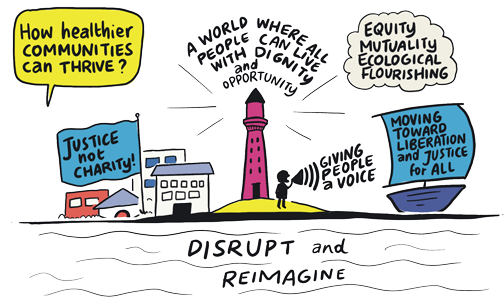
We’re now a different organisation from a few years ago. We publish a revised approach to change – The Change We Want to See – which centres justice, equity and inclusion.
Our work now includes an explicit focus on alternatives to the dominant colonial capitalist economic model.
2021
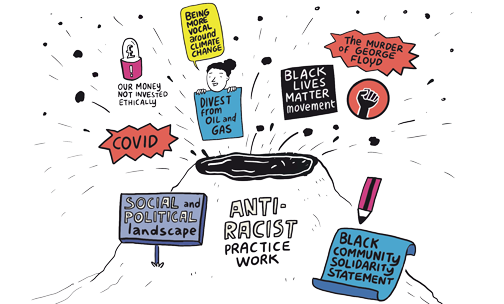
COVID-19
We remove any project-based conditions from our grants and make emergency funds available. The need to act swiftly demolishes some of the remaining decision making hierarchy inside Lankelly.
New board, new perspectives
Five new trustees join us, each with a formidable track record of integrating and activating their learned, lived and practice experience to tackle systems of injustice.
This move comes with the clear intention “not to sit within business as usual, but to open up less comfortable spaces where more transformative possibilities lie”.
‘Are you really up for it?’ – challenge from outside
At the same time, narratives critical of philanthropy are building. Grantees and others in our networks are challenging us to really put ‘our’ money where our mouth is.
Lankelly Chase and white supremacy #3
The murder of George Floyd and the worldwide response galvanises a conviction that we have to demonstrate how central racial justice is to our mission.
We issue a statement, “Standing in Solidarity with the Black Community”, in which we signal our own complicity in institutional racism and our commitment to change.
We are invited to invest in Resourcing Racial Justice (RRJ) and Baobab Foundation. We write a racial justice accountability plan as a requirement of becoming an RRJ funder.
Lankelly’s strategy moves from addressing severe and multiple disadvantage to tackling systems of oppression.
2020
The endowment #2
By now we recognise that when we say “we are part of the systems that need to change”, this has to include our endowment or it is meaningless.
As a first step we divest from fossil fuels.
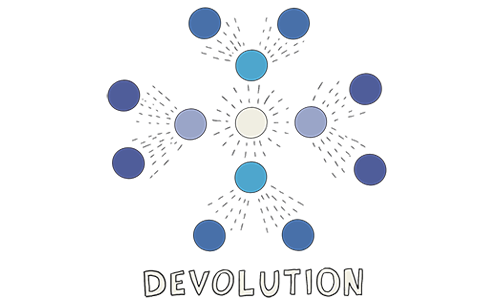
Devolution #2
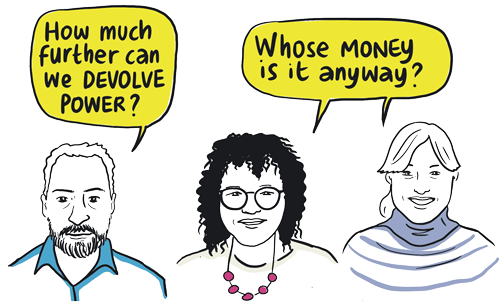
In our place-based work, we start to shift decision making over funding to groups of local people.
Inside the organisation there is a move away from hierarchical decision making towards a more equal structure.
Lankelly Chase and white supremacy #2
There is a challenge from women of colour in the team, some of whom experience Lankelly (and the world of ‘systems change’ in general) as over-intellectual, elitist and oppressive.
Lankelly’s (white) leadership team recognises that it has had insufficient understanding of racism, which has negatively affected colleagues and limited the emphasis we should be giving to racial justice.
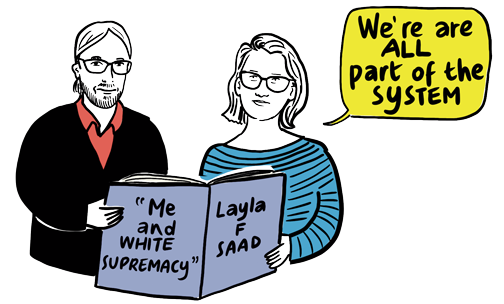
We take the first steps in the work of facing up to this, with white colleagues working through Layla Saad’s ‘Me and White Supremacy’ together.
2019
The ‘System Behaviours’
Through our work with grantees, we observe that healthy systems have some common underlying conditions. We co-produce a list of these (in dialogue with 200 organisations) and call them the ‘System Behaviours’.
Our view of our role changes as a result: our job is now to work to create these conditions. This is very different to a traditional funder.
We also believe that as part of the system, we must embody these conditions ourselves. This is a critical realisation that paves the way for later events.
Emerging contradictions
A sense of the contradictory nature of our position is already present. In our 2018-19 annual review we say:
“We have become more and more aware of the privileged space we hold in an unequal system… Who are we to have control over this resource?”
2018
From programmes to inquiries
We shift from a programmes-based approach to an action inquiry approach. This is because there is no clear route to the change we are seeking – trial and error (or learning and adaptation) is needed.

2017
After more than 40 years, the Board lets go of making every grant decision and delegates this to the staff.
This means we have to pay attention to how decisions are made in the team. We start to explore tools for effective dialogue.
Lankelly Chase and white supremacy #1
Aware the way we define ‘severe and multiple disadvantage’ has taken us down a particular road away from issues around racial justice, there is an attempt to rebalance things. At this point we don’t do the internal work and acknowledge how white supremacy is at play inside Lankelly.
Place as a system boundary
We begin the work on ‘place’ that will last through to 2025.
2016
Hard Edges
We publish ‘Hard Edges’, an influential report profiling people facing severe and multiple disadvantage.
Deep dialogue with grantees
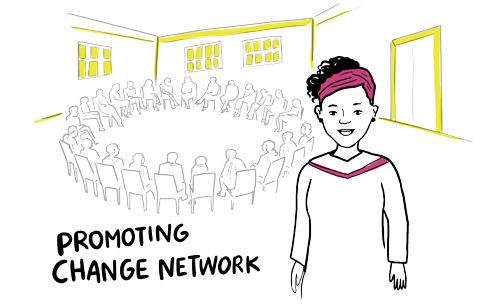
The Promoting Change Network of grantees has expanded. We are running regular retreats where there is deep conversation about systems change.
2015
Becoming aware of complexity and systems thinking
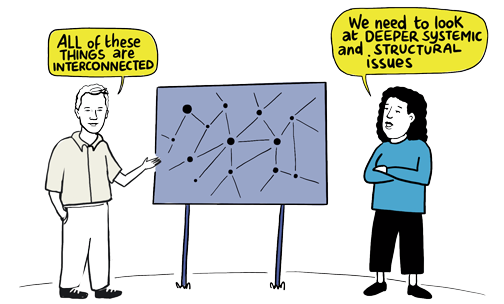
We’re realising that ‘severe and multiple disadvantage’ is a complex problem, not amenable to simplistic or linear solutions.
We start to learn about ‘systems change’ as an approach appropriate for complexity.
We become known as the ‘systems change funder’ (though none of us are experts in systems thinking).
2014
A funder with a theory of change…
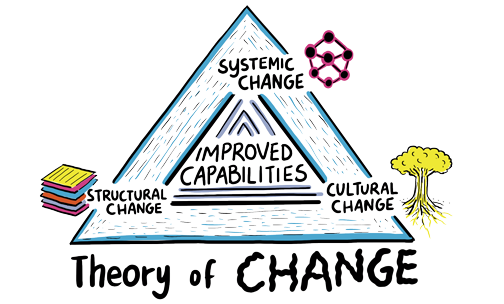
We publish a Theory of Change – the first UK foundation to do so.
It indicates our ambition to use the foundation’s position – the amazing combination of freedom and resources – to leverage change.
Out with the old and in with the new
We close all the old programmes and put out a call for organisations working on systems change and severe and multiple disadvantage.
600+ applications come in. We select just 15 to form the initial ‘Promoting Change Network’ (PCN).
Our concern with the new mission drives us forward and we barely stop to think about the organisations we are moving away from, at least a third of which are led by people of colour.
The PCN – a group of organisations brought together specifically around disadvantage in the UK – included one organisation led by people of colour.
2013
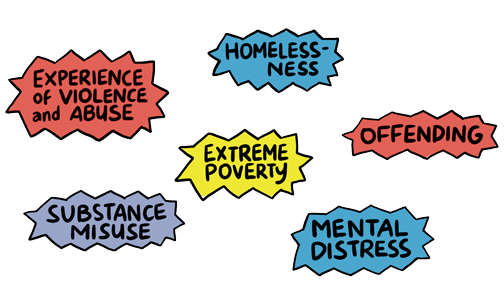
‘Severe and multiple disadvantage’
The strategic review results in a new mission:
“Lankelly Chase works to bring about change that will transform the quality of life of people who face severe and multiple disadvantage“.
By this we mean the way severe social harms intersect and reinforce each other. As far as we know, we coin this term (something we go on to have mixed feelings about).
2012
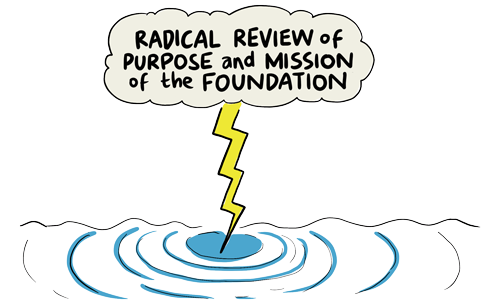
A new strategy
A new CEO joins the foundation and as new CEOs do, he kicks off a strategic review of the foundation’s objectives and work.
2011
Grants for ‘unpopular causes’
Lankelly Chase gives grants to charities working on racism and mental health, domestic abuse, women in the criminal justice system, short term prisoners, immigration detention, the arts and community development.
The endowment #1
Lankelly Chase has £118m invested in the stock market. Our investment strategy is “to maintain the real value of the endowment portfolio whilst maximising the income available”.
We’re not yet engaging with what that endowment is doing in the world.
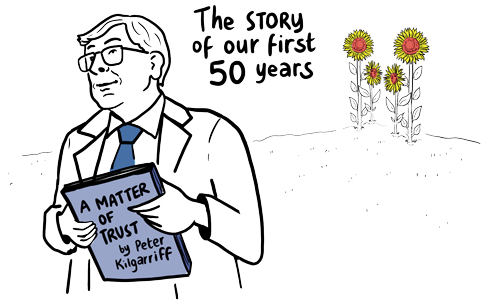
The story to 2010…
Lankelly’s history up to 2010 is written up by our former CEO, Peter Kilgarriff, in ‘A Matter of Trust’.
This recounts the story of our beginnings – how the Lankelly Chase endowment originated in the combined legacies of Major Alfred Allnatt and Ron Diggens, who had worked together in the development of land and property around London. They established the Chase Charity and the Lankelly Foundation in the 1960s. These merged to become Lankelly Chase Foundation in 2004.